Congratulations!
Your offer has been accepted and you’re officially under contract on a new home.
This is one of the most exciting milestones in the homebuying journey, but it’s also where many buyers begin asking:
“Now what?”
At Carolina Mortgage Firm, we guide buyers throughout Charlotte, Fort Mill, Indian Land, Rock Hill, Lancaster, Waxhaw, Matthews, Belmont, and surrounding communities through this process every day.
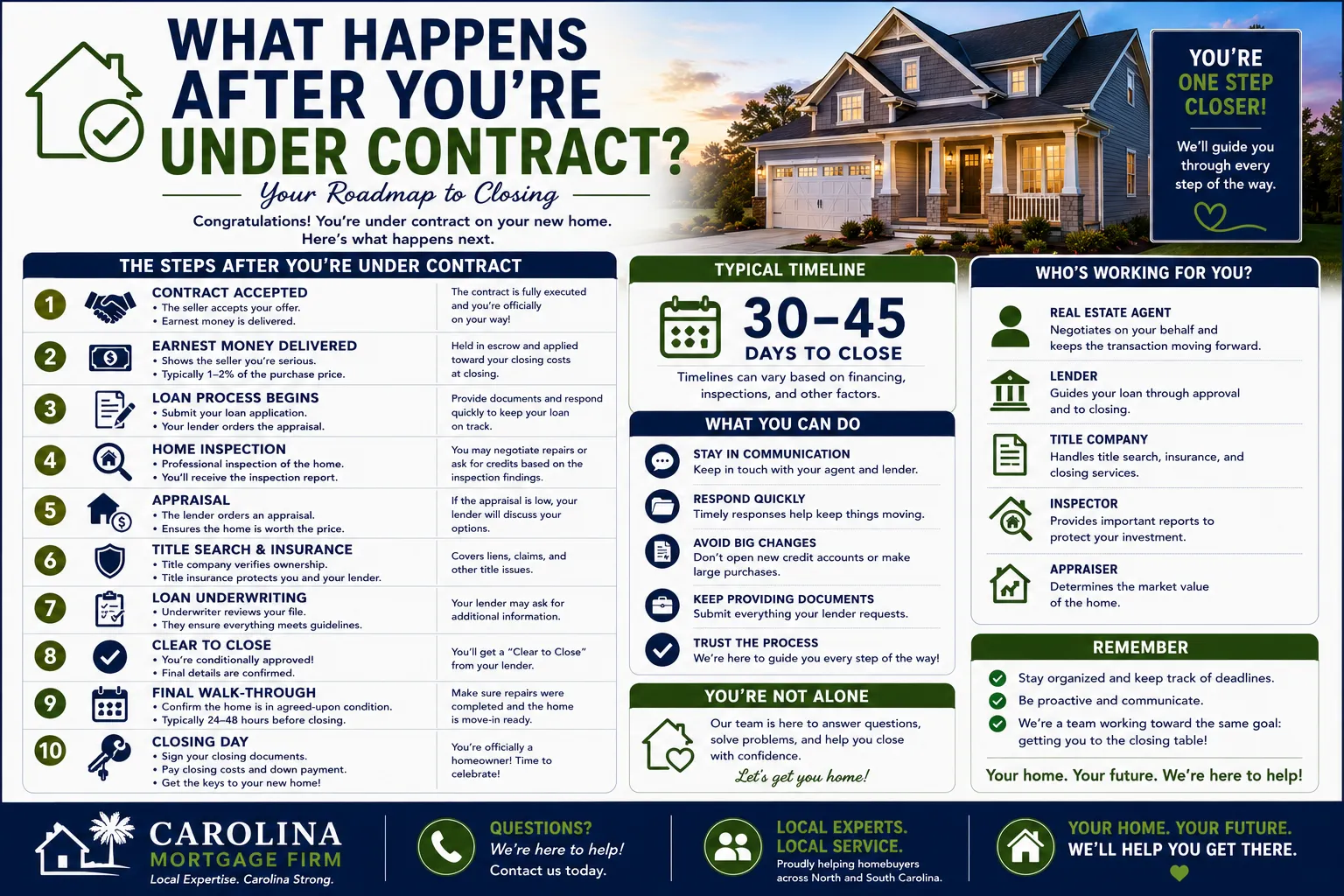
While every transaction is unique, most home purchases follow a similar timeline from contract to closing.
Understanding what happens next can help reduce stress, avoid surprises, and ensure a smoother homebuying experience.
Step 1: Deliver the Contract
Once the purchase agreement is fully executed, your Realtor will typically provide the contract to all parties involved.
This often includes:
- Mortgage lender
- Closing attorney
- Buyer
- Seller
- Real estate agents
The mortgage process officially begins moving into full production.
At Carolina Mortgage Firm, we immediately begin reviewing the contract and preparing the file for underwriting.
Step 2: Update Your Mortgage Application
Even if you were already pre-approved, your loan file may need updates. Common items reviewed include:
Purchase Price
Ensuring the loan structure matches the final contract.
Closing Date
Confirming financing timelines.
Seller Concessions
Reviewing credits toward closing costs or rate buydowns.
Property Information
Updating address and property details.
These updates ensure your loan reflects the actual transaction.
Step 3: Initial Loan Disclosures
Federal regulations require borrowers to receive loan disclosures shortly after application. These documents outline:
- Loan terms
- Estimated closing costs
- Interest rate information
- Payment estimates
It’s important to review disclosures promptly and sign electronically when requested.
Delays at this stage can impact closing timelines.
Step 4: Home Inspection
Most buyers choose to complete a home inspection shortly after going under contract. A home inspection helps identify:
- Structural concerns
- Electrical issues
- Plumbing problems
- HVAC deficiencies
- Safety concerns
The inspection protects buyers by providing a better understanding of the property’s condition. While lenders generally don’t require inspections, they are highly recommended.
Step 5: Earnest Money and Due Diligence
Depending on your market and contract structure, you may have already submitted:
Earnest Money
Demonstrates your commitment to purchasing the property.
Due Diligence Funds
Common in North Carolina transactions.
Be sure to keep documentation showing these payments. Your lender may request copies during underwriting.
Step 6: Loan Processing Begins
Your file is assigned to processing.
The processor reviews documentation such as:
- Income
- Assets
- Credit
- Employment
- Property information
The goal is preparing the file for underwriting review.
During this stage, additional documentation requests are common. This is normal and should not cause concern.
Step 7: Appraisal Ordered
The lender typically orders an appraisal. The appraiser evaluates:
- Property condition
- Comparable sales
- Market value
The purpose is to ensure the property’s value supports the loan amount.
Most buyers are unfamiliar with the appraisal process, but it is a standard part of nearly every mortgage transaction.
Step 8: Underwriting Review
This is often the step that creates the most anxiety. The underwriter reviews:
Income
Verifies qualifying income.
Assets
Confirms funds available for closing.
Credit
Evaluates credit history and liabilities.
Property
Reviews appraisal and property documentation.
The underwriter’s role is ensuring the loan meets investor guidelines.
Step 9: Conditions
After reviewing the file, the underwriter may issue conditions. Common examples include:
- Updated bank statements
- Additional pay stubs
- Explanations for deposits
- Employment verification Receiving conditions is normal.
Almost every loan receives some form of conditional approval. Prompt responses help keep the transaction moving.
Step 10: Clear to Close
One of the best phone calls in the mortgage process is:
“You’re Clear to Close!”
This means:
- Underwriting requirements have been satisfied
- Final approval has been issued
- Closing documents can be prepared At this stage, you’re nearly at the finish line.
Step 11: Closing Disclosure
Borrowers receive a Closing Disclosure (CD) prior to closing.
The CD outlines:
- Final loan terms
- Interest rate
- Monthly payment
- Closing costs
- Cash needed to close
Reviewing the CD carefully is important.
Your mortgage advisor should be available to answer questions.
Step 12: Final Walkthrough
Shortly before closing, buyers typically complete a final walkthrough. The purpose is confirming:
- Agreed repairs were completed
- Property condition remains acceptable
- No unexpected issues exist This is not a second inspection.
It’s a final verification.
Step 13: Closing Day
Closing day has finally arrived. At closing, you’ll:
- Sign loan documents
- Review final paperwork
- Provide any required funds
- Receive ownership documentation
Once the transaction funds and records, you’re officially a homeowner. Congratulations!
Common Mistakes Buyers Make While Under Contract
Opening New Credit Accounts
Avoid financing furniture, appliances, or vehicles.
Changing Jobs
Employment changes can affect loan approval.
Moving Money Between Accounts
Large undocumented transfers can create underwriting questions.
Missing Document Requests
Responding quickly helps prevent delays.
Making Large Purchases
Avoid major financial changes until after closing.
How Long Does the Process Take?
Most transactions close within:
30 to 45 Days
However, timelines vary based on:
- Loan program
- Property type
- Appraisal timing
- Underwriting conditions
- Contract terms
Preparation and communication are key.
Why Work With Carolina Mortgage Firm?
At Carolina Mortgage Firm, we guide buyers throughout:
- Charlotte
- Fort Mill
- Indian Land
- Rock Hill
- Lancaster
- Matthews
- Waxhaw
- Belmont
- Concord
- Huntersville
through every step of the mortgage process. We provide:
- Weekly updates
- Clear communication
- Fast responses
- Multiple loan options
- Local expertise
Our goal is making the homebuying process as smooth and stress-free as possible.
Frequently Asked Questions
How Long Does Underwriting Take?
Typically a few days, though timelines vary.
What If the Appraisal Comes In Low?
Several options may be available depending on the circumstances.
Can I Buy Furniture Before Closing?
It’s usually best to wait until after closing.
What Does Clear to Close Mean?
Final underwriting approval has been issued.
When Do I Get the Keys?
Typically after the transaction funds and records.
Related Mortgage Resources
- Mortgage Pre-Approval Guide
- First-Time Homebuyer Programs
- FHA vs Conventional Loans
- How Much House Can I Afford?
- Mortgage Rate Lock Strategies
- Mortgage Broker vs Bank
Ready to Buy a Home?
Whether you’re purchasing your first home in Charlotte, moving to Fort Mill, relocating to Indian Land, buying in Rock Hill, or upgrading in Lancaster County, Carolina Mortgage Firm can guide you through every step of the mortgage process.
Contact our team today for a personalized mortgage consultation and pre-approval.