If you’re self-employed, own a business, work as an independent contractor, or earn income through commissions, you’ve likely experienced one of the most frustrating parts of the mortgage process:
“Your tax returns don’t show enough income.”
At Carolina Mortgage Firm, we hear this frequently from successful business owners throughout Charlotte, Fort Mill, Indian Land, Rock Hill, Lancaster, Waxhaw, Matthews, and surrounding communities.
The reality is that many self-employed borrowers make excellent incomes but strategically reduce taxable income through legitimate business deductions. While these deductions may lower taxes, they can also create challenges when qualifying for a traditional mortgage.
Fortunately, bank statement loans provide an alternative solution.
These programs are specifically designed for self-employed borrowers whose actual cash flow may be stronger than what appears on tax returns.
What Is a Bank Statement Loan?
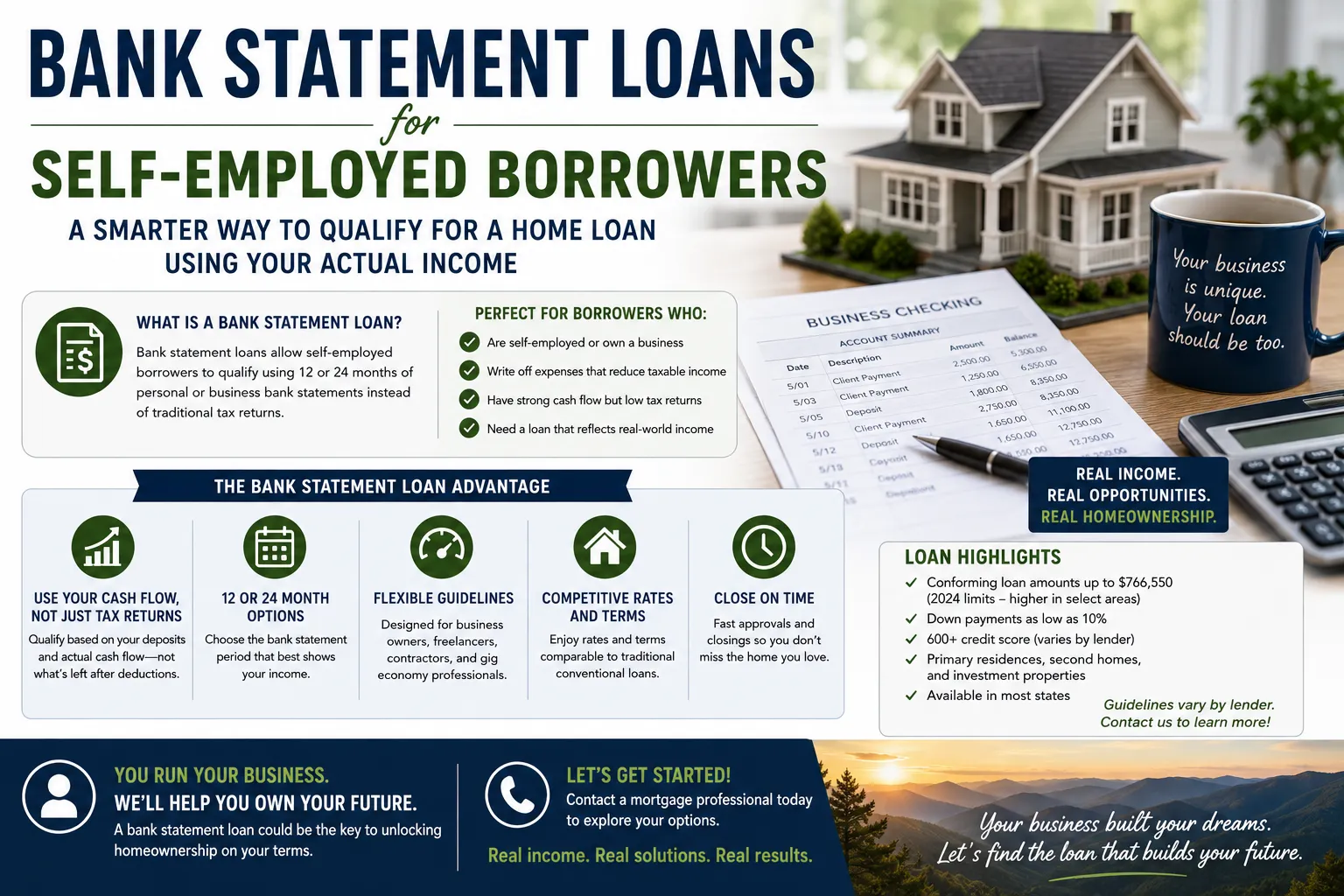
A bank statement loan is a mortgage program that allows lenders to evaluate income using bank deposits rather than traditional tax return calculations.
Instead of focusing primarily on:
- W-2s
- Tax returns
- Adjusted Gross Income (AGI)
the lender analyzes:
- Personal bank statements
- Business bank statements
- Deposit history
- Cash flow trends
This approach often allows self-employed borrowers to qualify based on the strength of their business rather than their taxable income.
Who Uses Bank Statement Loans?
These programs are popular among:
Business Owners
Owners of LLCs, S-Corporations, Partnerships, and Sole Proprietorships.
Independent Contractors
Professionals who receive 1099 income.
Real Estate Professionals
Agents and brokers whose income fluctuates throughout the year.
Consultants
Independent consultants often benefit from alternative income documentation.
Medical Professionals
Doctors and healthcare providers with private practices frequently utilize these programs.
Sales Professionals
Commission-based earners often have substantial cash flow not fully reflected on tax returns.
Why Traditional Mortgage Qualification Can Be Difficult
Traditional mortgage underwriting relies heavily on tax returns.
This creates challenges because many self-employed individuals:
- Deduct vehicle expenses
- Deduct office expenses
- Deduct travel expenses
- Utilize depreciation
- Write off business equipment
- Maximize tax strategies
While these deductions reduce taxable income, they may also reduce qualifying income. For example:
A business owner generating $250,000 in annual revenue may show significantly less taxable income after deductions.
A traditional lender focuses on taxable income.
A bank statement lender focuses more heavily on actual deposits and cash flow.
How Bank Statement Loans Work
The lender reviews bank statements to determine average monthly income. Most programs require:
12 Months of Statements
Some lenders offer programs based on 12 months of deposits.
24 Months of Statements
Others prefer a longer history.
Personal Bank Statements
Used when business income flows directly into personal accounts.
Business Bank Statements
Used when business income remains separate.
The lender analyzes deposits and applies approved calculation methods to determine qualifying income.
Advantages of Bank Statement Loans
Higher Qualifying Income
Many borrowers qualify for larger loan amounts than they would using tax returns alone.
Alternative Documentation
No need to rely solely on adjusted gross income.
Business-Friendly Underwriting
Programs are specifically designed for entrepreneurs.
Flexibility
Multiple options exist depending on business structure and income sources.
Homeownership Opportunities
Borrowers who may not qualify conventionally often find success with bank statement financing.
What Types of Properties Can Be Financed?
Many bank statement programs allow financing for:
Primary Residences
Owner-occupied homes.
Second Homes
Vacation and seasonal properties.
Investment Properties
Certain programs permit non-owner occupied financing.
New Construction
Some programs allow purchases of newly built homes. Property eligibility varies by lender and program.
How Much Down Payment Is Required?
Down payment requirements vary. Factors include:
- Credit score
- Loan amount
- Occupancy type
- Property type
Many borrowers are surprised to discover down payment requirements are often lower than expected. A customized mortgage consultation can determine available options.
Credit Score Requirements
Bank statement loans generally require stronger credit profiles than government-backed financing. However, exact requirements vary.
Higher credit scores often result in:
- Better rates
- Lower down payment requirements
- More loan options
Borrowers should review their credit profile before applying.
Common Self-Employed Mortgage Mistakes
Waiting Until Tax Returns Are Filed
Planning ahead often creates more opportunities.
Assuming You Won’t Qualify
Many successful entrepreneurs qualify through alternative documentation programs.
Mixing Personal and Business Funds
Clear documentation often makes qualification easier.
Choosing the Wrong Lender
Not all lenders offer strong self-employed mortgage solutions.
Example Scenario
Consider a self-employed business owner in Fort Mill. Their tax returns show:
$75,000 annual income
However, their business deposits exceed:
$20,000 per month
A traditional lender focuses on taxable income. A bank statement lender evaluates cash flow.
The result may be significantly greater purchasing power.
This is why bank statement loans have become increasingly popular throughout the Carolinas.
Bank Statement Loans vs Traditional Mortgages
Traditional Mortgage
Pros:
Cons:
- Lower rates
- Wider lender availability
- Standard documentation
- Tax-return driven
- Less flexible for entrepreneurs Bank Statement Mortgage Pros:
- Cash-flow based qualification
Cons:
- Entrepreneur-friendly
- Higher potential qualifying income
- May involve higher rates
- Additional underwriting review
The right choice depends on your financial profile.
Why Pre-Approval Matters
Self-employed borrowers should obtain a mortgage consultation early. Benefits include:
Understanding Options
Identify whether traditional or alternative financing is best.
Income Analysis
Review qualification methods before shopping.
Budget Planning
Know exactly what price range fits your goals.
Avoiding Surprises
Address potential issues before finding a home.
Why Work With Carolina Mortgage Firm?
At Carolina Mortgage Firm, we specialize in helping self-employed borrowers throughout:
- Charlotte
- Fort Mill
- Indian Land
- Rock Hill
- Lancaster
- Matthews
- Waxhaw
- Belmont
- Huntersville
- Concord
navigate complex income situations.
Because we work with multiple lenders, we can compare:
- Conventional Financing
- Bank Statement Loans
- DSCR Loans
- Investor Financing
- Jumbo Loans
- Non-QM Programs
Our goal is helping business owners find financing solutions that fit their unique circumstances.
Frequently Asked Questions
Do I Need Tax Returns?
Some programs may not require tax returns for qualification purposes.
How Many Months of Statements Are Required?
Typically 12 to 24 months.
Can Business Statements Be Used?
Yes.
Are Bank Statement Loans Only for Business Owners?
No. Independent contractors and other self-employed borrowers may qualify.
Are Rates Higher?
They can be, depending on the program and borrower profile.
Related FHA Resources
Ready to Explore Your Mortgage Options?
If you’re self-employed and have been told you don’t qualify based on your tax returns, there may be another solution.
Whether you’re purchasing in Charlotte, Fort Mill, Indian Land, Rock Hill, Lancaster, Matthews, Waxhaw, or anywhere throughout North or South Carolina, Carolina Mortgage Firm can help evaluate your income and identify financing options designed specifically for entrepreneurs.
Contact our team today for a personalized mortgage consultation.