One of the most common questions aspiring real estate investors ask is:
“Can I buy an investment property with an FHA loan?”
The answer is:
Not exactly—but there are some powerful exceptions.
While FHA loans are designed for owner-occupied properties and generally cannot be used to purchase traditional investment properties, there are strategies that allow borrowers to use FHA financing to begin building a real estate portfolio.
At Carolina Mortgage Firm, we regularly help buyers throughout Charlotte, Fort Mill, Indian Land, Rock Hill, Lancaster, Matthews, Waxhaw, and surrounding communities understand how FHA financing can fit into their long-term investment goals.
Let’s explore what FHA allows, what it doesn’t allow, and how many successful investors get started using FHA financing.
Quick Answer: FHA Loans Require Owner Occupancy
FHA loans are intended for:
Primary Residences
The borrower must intend to occupy the property as their primary residence.
FHA loans generally cannot be used to purchase:
- Rental properties
- Vacation homes
- Second homes
- Non-owner occupied investment properties
At least one borrower must intend to occupy the home. This is one of FHA’s core requirements.
Why FHA Has Occupancy Requirements
The FHA program was created to promote homeownership, not real estate investing.
Because owner-occupied properties historically present lower risk than investment properties, FHA financing offers:
- Lower down payments
- Flexible credit requirements
- Competitive interest rates
In exchange, borrowers agree to use the property as their primary residence.
What Is an Investment Property?
An investment property is a property purchased primarily to generate income. Examples include:
Long-Term Rentals
Properties leased to tenants.
Short-Term Rentals
Airbnb and vacation rentals.
Vacation Homes
Properties not used as a primary residence.
Rental Portfolios
Properties owned strictly for investment purposes.
These property types generally require financing other than FHA.
The FHA House Hacking Strategy
While FHA loans cannot typically be used for traditional investment properties, they can often be used for a strategy known as:
House Hacking
House hacking involves:
- Purchasing a property as your primary residence
- Living in part of the property
- Renting out other portions
This allows buyers to generate income while satisfying FHA occupancy requirements. Many successful investors purchased their first property using this strategy.
Can FHA Be Used for Duplexes, Triplexes, and Fourplexes?
Yes.
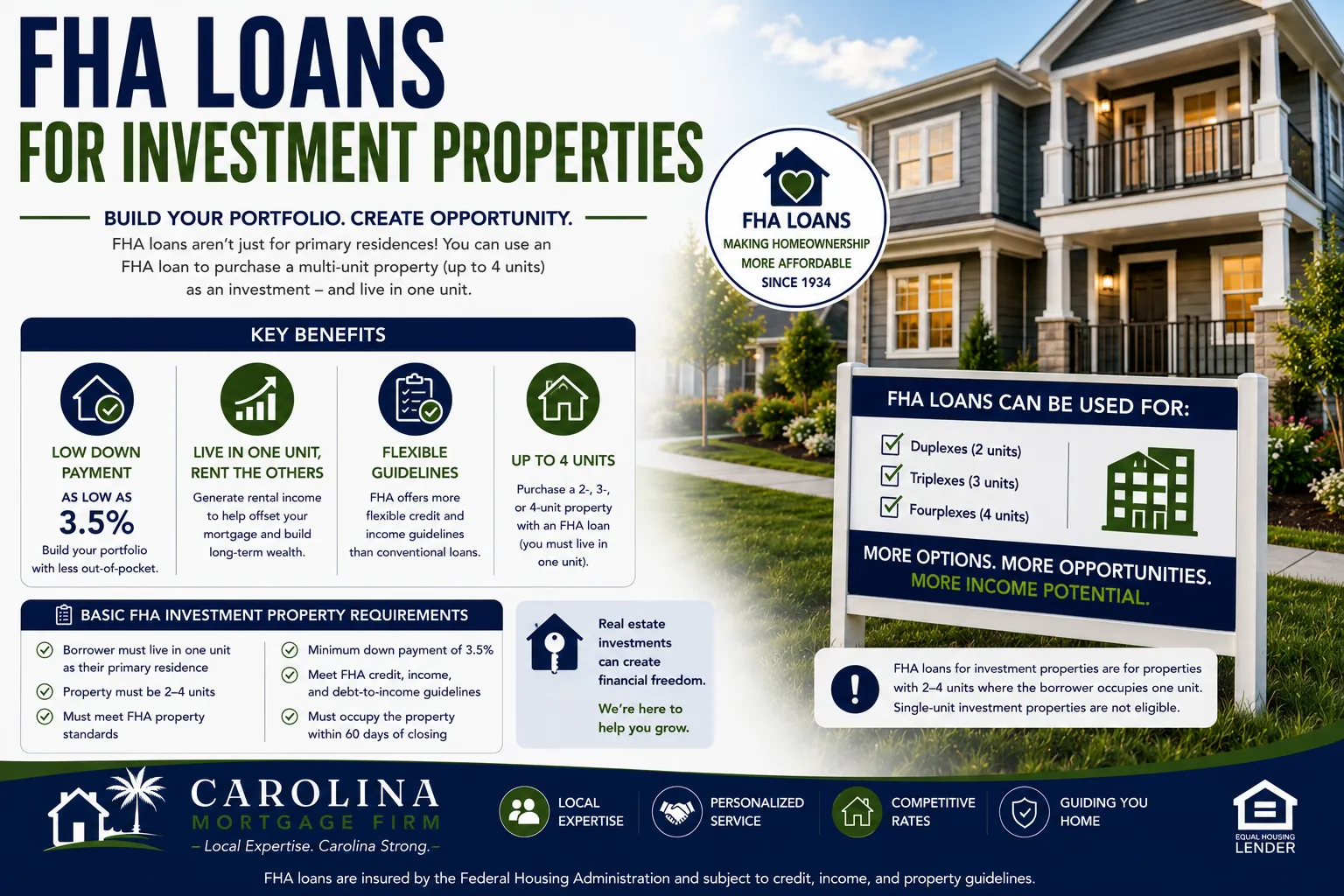
This is one of FHA’s most powerful features. Borrowers may purchase:
Duplexes
Two-unit properties.
Triplexes
Three-unit properties.
Fourplexes
Four-unit properties.
The key requirement is:
The borrower must live in one of the units as their primary residence.
The remaining units may often be rented to tenants.
This is one of the most effective ways first-time investors enter real estate investing.
Example of FHA House Hacking
Let’s say you purchase:
A Fourplex in Rock Hill
You live in one unit. Three units are rented.
Potential benefits may include:
- Rental income
- Lower out-of-pocket down payment
- Long-term appreciation
- Wealth building opportunities
Many investors use this strategy to transition from homeowner to landlord.
Can Rental Income Help Me Qualify?
In many situations, yes.
For multi-unit properties, projected rental income may be considered during qualification. This can potentially:
Increase Purchasing Power Improve Qualification Expand Financing Options
The exact treatment depends on loan guidelines and documentation.
How Long Must I Live in the Property?
FHA generally requires borrowers to occupy the property as their primary residence. Occupancy certification is part of the loan process.
Borrowers should always be truthful about occupancy intentions. Misrepresenting occupancy can create serious legal and financial consequences.
Can I Move Later and Keep the Property?
Many borrowers eventually relocate due to:
- Job changes
- Family growth
- Marriage
- Relocation opportunities
Once occupancy requirements have been satisfied, future property decisions may be possible. However, borrowers should always purchase with a genuine intent to occupy the property initially.
What FHA Does NOT Allow
FHA generally does not permit:
Pure Investment Property Purchases
Properties intended solely for rental purposes.
Vacation Homes
Properties used primarily for recreation.
Second Homes
Properties occupied only occasionally.
Non-Occupant Investors
Borrowers with no intention of living in the property.
For these scenarios, conventional investment property financing is usually required.
Alternative Investment Property Loan Options
Once you’re ready to purchase a traditional investment property, several financing options may be available.
Conventional Investment Property Loans
Popular among experienced investors.
DSCR Loans
Focus heavily on property cash flow.
Bank Statement Loans
Helpful for self-employed investors.
Portfolio Loans
Offer additional flexibility in some situations.
These programs are designed specifically for investment properties.
Common FHA Investment Property Myths
Myth #1: FHA Can Be Used for Any Rental Property
False.
Owner occupancy is required.
Myth #2: FHA Can’t Help Investors
False.
House hacking has launched countless investment careers.
Myth #3: Multi-Unit FHA Properties Aren’t Allowed
False.
FHA often permits up to four units.
Myth #4: You Need Huge Cash Reserves to Start Investing
False.
FHA’s low down payment requirement can make investing more accessible.
Why FHA Is Popular With New Investors
Many first-time investors choose FHA because it offers:
Low Down Payment Requirements Flexible Credit Guidelines
Multi-Unit Property Opportunities Potential Rental Income
For motivated buyers, FHA can be an excellent first step into real estate investing.
Why Pre-Approval Matters
Before pursuing a duplex, triplex, or fourplex, obtaining a mortgage pre-approval is critical. Benefits include:
Understanding Budget
Know what property types fit your goals.
Reviewing Rental Income Opportunities
Evaluate qualification options.
Comparing Loan Programs
Review FHA, Conventional, VA, and USDA financing.
Moving Quickly
Investment opportunities often move fast.
Why Work With Carolina Mortgage Firm?
At Carolina Mortgage Firm, we help buyers throughout:
- Charlotte
- Fort Mill
- Indian Land
- Rock Hill
- Lancaster
- Matthews
- Waxhaw
- Belmont
- Huntersville
- Concord
understand FHA occupancy requirements and explore strategies for building wealth through real estate. Because we work with multiple lenders, we can compare:
- FHA Loans
- Conventional Loans
- DSCR Loans
- Bank Statement Loans
- Investment Property Financing to help create a customized strategy.
Frequently Asked Questions
Can I Buy a Rental Property With FHA?
Generally no, unless you occupy the property.
Can I Buy a Duplex With FHA?
Often yes.
Can I Buy a Fourplex With FHA?
Yes, provided you occupy one of the units.
Can Rental Income Help Me Qualify?
Often yes for multi-unit properties.
Is House Hacking Legal With FHA?
Absolutely, when FHA occupancy requirements are followed.
Related FHA Resources
- What Credit Score Do I Need for an FHA Loan?
- FHA Down Payment Requirements
- FHA Gift Funds Requirements
- FHA Student Loan Guidelines
- FHA Loan Limits in North and South Carolina
Ready to Explore FHA Multi-Unit Financing?
Whether you’re looking to purchase your first duplex in Charlotte, a triplex in Rock Hill, a fourplex in Lancaster, or begin building long-term wealth through real estate, Carolina Mortgage Firm can help you understand your options.
Contact our team today for a personalized FHA consultation and mortgage pre-approval.