If you’re paid on commission, you’ve probably wondered:
“Can I use my commission income to qualify for a mortgage?”
The answer is:
Yes, in many cases commission income can be used to qualify for a mortgage.
However, commission income is evaluated differently than salary or hourly income because it can fluctuate from year to year.
At Carolina Mortgage Firm, we help Realtors, loan officers, insurance agents, pharmaceutical sales representatives, car sales professionals, financial advisors, recruiters, and many other commission-based professionals throughout Charlotte, Fort Mill, Indian Land, Rock Hill, Lancaster, Matthews, Waxhaw, and surrounding communities successfully qualify for home financing.
Let’s explore how mortgage lenders evaluate commission income and what you can do to maximize your purchasing power.
Quick Answer: Commission Income Is Often Eligible
Most mortgage programs allow commission income when it can be properly documented and demonstrated as stable and likely to continue.
Lenders typically review:
Commission History
How long you’ve been earning commissions.
Income Stability
Whether earnings are reasonably consistent.
Employment History
Length of time in your profession.
Income Trends
Whether earnings are increasing, stable, or declining.
Because commission income varies from borrower to borrower, each file receives individual review.
What Is Considered Commission Income?
Commission income is compensation earned based on performance, sales volume, production, or revenue generation.
Examples include:
Real Estate Agents Mortgage Loan Officers Insurance Agents
Car Sales Professionals Financial Advisors Recruiters
Pharmaceutical Representatives Business Development Professionals
Many Charlotte-area professionals earn a significant portion of their compensation through commissions.
Why Lenders Evaluate Commission Income Differently
Unlike salary income, commission income may fluctuate. For example:
Year One: $75,000 Year Two: $110,000 Year Three: $95,000
Because earnings can vary, lenders must determine:
- Stability
- Continuance
- Average qualifying income
Their goal is ensuring borrowers can comfortably repay the mortgage over the long term.
How Much Commission History Is Required?
In most cases, lenders prefer:
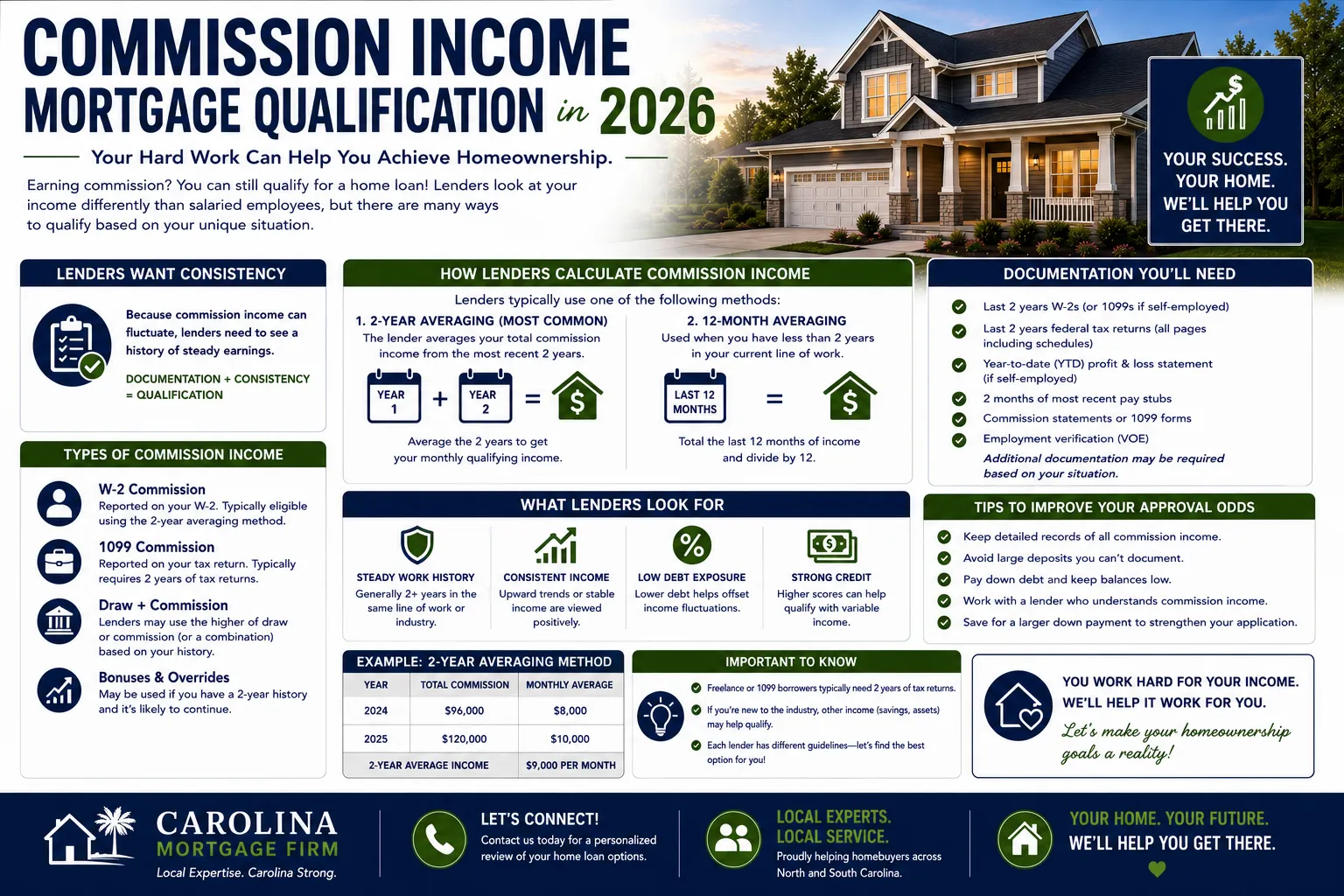
Two Years of Commission Income
A two-year history provides the strongest documentation.
However, this doesn’t necessarily mean less than two years automatically disqualifies a borrower. Factors such as:
- Prior industry experience
- Employment history
- Income stability may also be considered.
Every situation should be reviewed individually.
How Is Commission Income Calculated?
Lenders generally review historical earnings and establish an average.
For example:
Year 1: $90,000
Year 2: $110,000
Average Annual Income: $100,000 Monthly Qualifying Income: $8,333
The exact calculation depends on program guidelines and income documentation.
What Documents Are Required?
Commission income borrowers should expect to provide:
W-2 Forms Recent Pay Stubs Tax Returns
Year-to-Date Earnings Information
Additional documentation may be required depending on the percentage of income derived from commissions.
A mortgage professional can help determine exactly what is needed.
What If My Commission Income Is Increasing?
This is a common situation.
Many professionals experience growth as they advance in their careers. Examples include:
- Realtors building their client base
- Loan officers increasing production
- Sales professionals expanding territories
- Financial advisors growing assets under management
Increasing income trends are often viewed positively. However, lenders still evaluate sustainability and consistency.
What If My Income Varies Significantly?
Some variation is expected.
Many commission-based careers naturally experience:
- Seasonal fluctuations
- Market cycles
- Production swings
- Economic influences
The key is establishing a reliable long-term earnings pattern.
Mortgage guidelines are designed to account for reasonable fluctuations.
Commission Income and Self-Employment
Many borrowers confuse commission income with self-employment.
W-2 Commission Employee
Works for an employer and receives commissions.
Self-Employed Commission Earner
Operates independently or through a business entity.
The documentation and qualification process may differ significantly. Understanding your classification is important.
Can New Commission Income Be Used?
One of the most common questions we receive is:
“I recently switched to commission income. Can I still qualify?”
The answer depends on factors such as:
Previous Industry Experience Compensation Structure Employment History
Recent changes don’t automatically prevent qualification. However, additional review may be required.
Common Commission Income Myths
Myth #1: Commission Income Doesn’t Count
False.
Many borrowers qualify using commission income.
Myth #2: I Must Earn the Same Amount Every Year
False.
Income variation is expected.
Myth #3: Realtors Can’t Get Mortgages
False.
Thousands of Realtors obtain mortgages every year.
Myth #4: Commission Income Is Too Risky
Not necessarily.
Strong documentation and income history often support qualification.
How Commission Income Can Increase Buying Power
Many borrowers underestimate the impact of their commission earnings. For example:
Base Salary: $50,000
Average Annual Commission: $40,000 Total Qualifying Income: $90,000 Using all eligible income may increase:
Loan Eligibility Home Price Range Financing Flexibility Purchasing Power
A proper income analysis can make a substantial difference.
Why Pre-Approval Matters
If you earn commission income, pre-approval is one of the most important steps you can take. Benefits include:
Accurate Income Review
Determine what income may qualify.
Loan Program Comparison
Review Conventional, FHA, VA, and USDA options.
Budget Planning
Know exactly what you can afford.
Stronger Offers
Present a more competitive offer when you find a home.
Why Work With Carolina Mortgage Firm?
At Carolina Mortgage Firm, we regularly help commission-based professionals throughout:
- Charlotte
- Fort Mill
- Indian Land
- Rock Hill
- Lancaster
- Matthews
- Waxhaw
- Belmont
- Huntersville
- Concord
navigate mortgage qualification.
We understand the unique challenges associated with variable income and work with multiple lenders to identify solutions for:
- Realtors
- Loan Officers
- Insurance Agents
- Sales Professionals
- Financial Advisors
- Business Development Professionals
Our goal is helping you maximize your purchasing power while finding the right mortgage solution.
Frequently Asked Questions
Can Commission Income Be Used for a Mortgage?
Often yes.
How Much Commission History Do I Need?
Generally, lenders prefer an established history, often around two years.
Can Realtors Qualify for Mortgages?
Absolutely.
What Documents Are Required?
Typically tax returns, W-2s, pay stubs, and employment verification.
Should I Get Pre-Approved Before House Hunting?
Yes.
Related Conventional Resources
- What Credit Score Is Needed for a Conventional Loan?
- Can I Buy a Home With 3% Down?
- Can Bonus Income Be Used to Qualify?
- How Long Is a Mortgage Pre-Approval Good For?
- How Is Rental Income Calculated on a Conventional Loan?
Ready to See How Your Commission Income Impacts Your Buying Power?
Whether you’re a Realtor in Fort Mill, a financial advisor in Charlotte, an insurance agent in Rock Hill, a loan officer in Lancaster, or a sales professional anywhere throughout North or South Carolina, Carolina Mortgage Firm can help determine how your commission income fits into your mortgage qualification.
Contact Carolina Mortgage Firm today for a personalized mortgage consultation and pre-approval.