
One of the most common concerns among homebuyers is:
“What if I don’t qualify on my own?”
Whether you’re a first-time homebuyer, recently changed jobs, have student loan debt, or simply need additional income to qualify, adding a co-borrower may help.
The good news is that FHA loans allow co-borrowers in many situations.
At Carolina Mortgage Firm, we regularly help buyers throughout Charlotte, Fort Mill, Indian Land, Rock Hill, Lancaster, Waxhaw, Matthews, and surrounding communities understand whether adding a co-borrower may strengthen their mortgage application.
Let’s explore how FHA co-borrowers work and when they may be beneficial.
Quick Answer: FHA Allows Co-Borrowers
Yes.
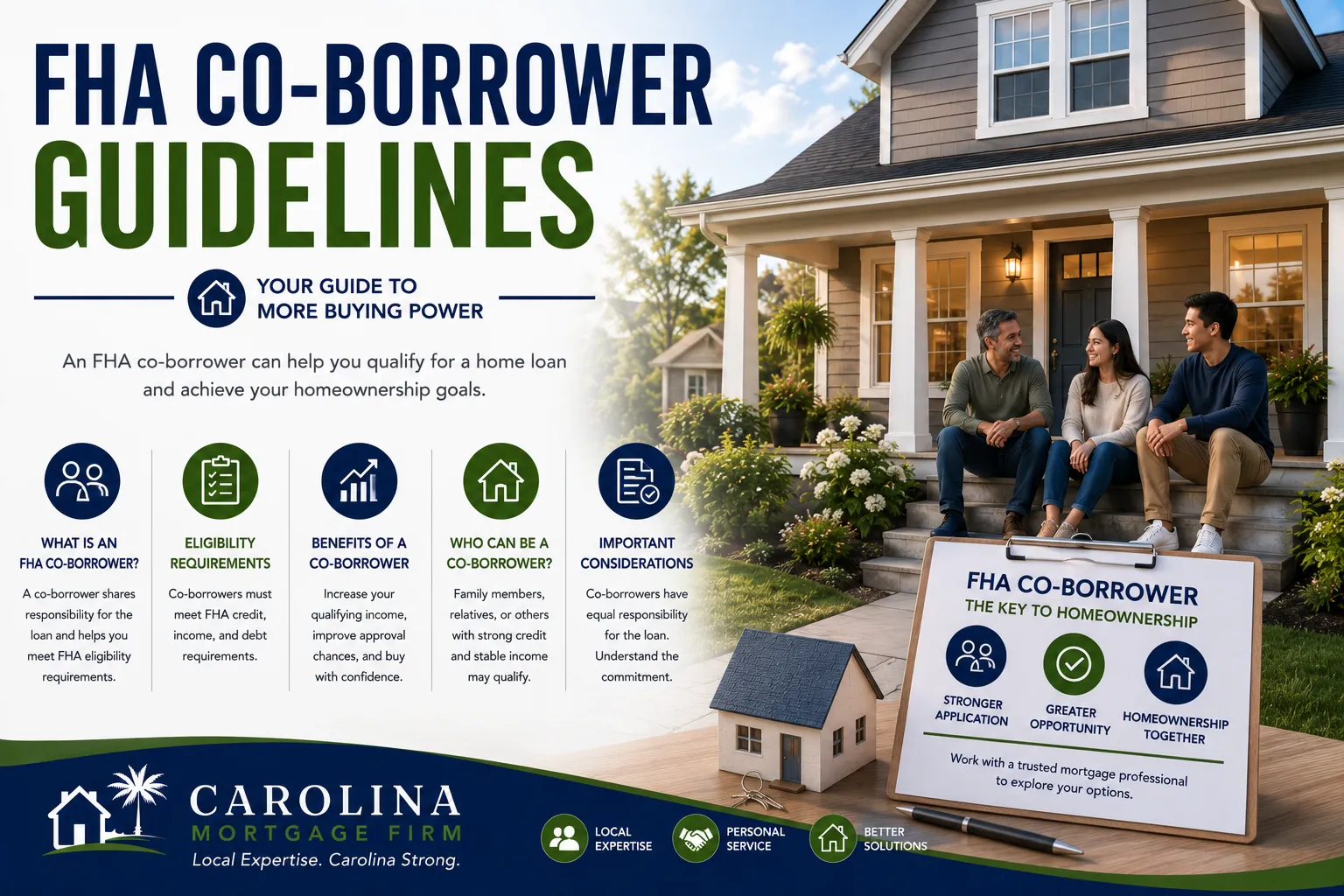
FHA financing allows borrowers to add a co-borrower to help qualify for a mortgage.
A co-borrower becomes legally responsible for the mortgage debt and is included in the loan qualification process.
The lender considers:
- Income
- Credit
- Assets
- Debts
for all borrowers included on the loan.
In many situations, adding a co-borrower can increase purchasing power and improve qualification opportunities.
What Is a Co-Borrower?
A co-borrower is an individual who applies for the mortgage alongside the primary borrower. The co-borrower:
- Signs the mortgage documents
- Shares legal responsibility for repayment
- Has their income considered
- Has their debts considered
- Has their credit reviewed
Because both borrowers are legally responsible for the loan, this should be a decision made carefully.
FHA Co-Borrower vs Co-Signer
Many people use these terms interchangeably, but they are not always identical.
Co-Borrower
Typically has ownership interest in the property and participates fully in the loan application.
Co-Signer
May help qualify for the loan without intending to occupy the property.
FHA guidelines allow certain non-occupying borrowers under specific circumstances. Your mortgage advisor can help determine the most appropriate structure.
Who Can Be an FHA Co-Borrower?
Several individuals may qualify.
Spouse
One of the most common FHA co-borrowers.
Parent
Parents frequently assist first-time homebuyers.
Child
Adult children may sometimes serve as co-borrowers.
Sibling
Brothers and sisters may qualify.
Other Eligible Individuals
Certain non-family relationships may be permitted depending on the circumstances and lender guidelines. Every situation should be reviewed individually.
What Is a Non-Occupying Co-Borrower?
One of FHA’s unique features is the ability to allow certain non-occupying co-borrowers. This means:
The co-borrower helps qualify for the mortgage but does not intend to live in the property. Examples include:
- Parents helping children buy their first home
- Family members assisting with qualification
- Certain approved family-supported purchases
These situations are common among first-time homebuyers.
How Can a Co-Borrower Help Me Qualify?
Adding a co-borrower may improve qualification in several ways.
Additional Income
The lender may consider both borrowers’ income. This often increases purchasing power.
Stronger Credit Profile
A co-borrower with stronger credit may help strengthen the application.
Improved Debt-to-Income Ratio
Combined income may reduce overall DTI ratios.
Greater Financial Stability
Multiple income sources can provide additional strength.
Not every situation benefits from adding a co-borrower, which is why individual analysis is important.
When a Co-Borrower May Not Help
Adding a co-borrower is not always beneficial. Potential concerns include:
Significant Existing Debt
The co-borrower’s liabilities are also considered.
Credit Challenges
Poor credit may weaken the application.
High Existing Mortgage Obligations
Current housing expenses may affect qualification.
Limited Income
The additional income may not offset existing debt.
A full mortgage review helps determine whether adding a co-borrower is advantageous.
Can a Parent Help Me Buy My First Home?
Absolutely.
This is one of the most common FHA co-borrower scenarios.
For example:
A first-time buyer may have:
- Stable employment
- Good payment history
- Limited income history
Adding a parent as a co-borrower may provide:
- Additional qualifying income
- Increased purchasing power
- Greater financing flexibility
Many successful homebuyers use this strategy.
Do Both Borrowers Need Good Credit?
Both borrowers’ credit profiles will be reviewed.
However, qualification is not based solely on credit scores. Lenders evaluate:
- Income
- Employment
- Assets
- Debt obligations
- Credit history
A mortgage consultation can help determine how multiple borrowers affect eligibility.
Does the Co-Borrower Have to Live in the Home?
Not necessarily.
FHA allows certain non-occupying co-borrowers under approved circumstances. However, at least one borrower must occupy the property as a primary residence. FHA loans are not intended for investment property purchases.
Common FHA Co-Borrower Myths
Myth #1: Co-Borrowers Must Live Together
False.
Certain non-occupying co-borrowers are permitted.
Myth #2: Only Spouses Can Co-Borrow
False.
Parents, children, siblings, and others may qualify.
Myth #3: Adding a Co-Borrower Guarantees Approval
False.
The complete financial picture is reviewed.
Myth #4: Co-Borrowers Have No Responsibility
False.
Co-borrowers are legally responsible for the mortgage.
Why Pre-Approval Matters
If you’re considering adding a co-borrower, pre-approval becomes even more important. Benefits include:
Understanding Qualification
See how combined income impacts approval.
Reviewing Loan Options
Compare FHA, Conventional, VA, and USDA financing.
Evaluating Credit Profiles
Determine strengths and opportunities.
Creating a Homebuying Strategy
Know exactly what price range fits your goals.
Why Work With Carolina Mortgage Firm?
At Carolina Mortgage Firm, we help buyers throughout:
- Charlotte
- Fort Mill
- Indian Land
- Rock Hill
- Lancaster
- Matthews
- Waxhaw
- Belmont
- Huntersville
- Concord
navigate FHA co-borrower guidelines and determine the best financing strategy. Because we work with multiple lenders, we can compare:
- FHA Loans
- Conventional Loans
- VA Loans
- USDA Loans
- Down Payment Assistance Programs
to help you achieve your homeownership goals.
Frequently Asked Questions
Can My Parent Co-Sign for an FHA Loan?
Often yes.
Can a Non-Occupying Co-Borrower Help Me Qualify?
Yes, under certain FHA guidelines.
Does My Co-Borrower Need Good Credit?
Credit is reviewed, but qualification involves multiple factors.
Can a Friend Be My FHA Co-Borrower?
Possibly, depending on the situation and lender requirements.
Does the Co-Borrower Own the Home?
Ownership structure depends on how title is held and should be discussed with your attorney and mortgage advisor.
Related FHA Resources
- What Credit Score Do I Need for an FHA Loan?
- FHA Down Payment Requirements
- FHA Gift Funds Requirements
- FHA Student Loan Guidelines
- FHA Loan Limits in North and South Carolina
Ready to Explore FHA Financing?
If you’re wondering whether adding a co-borrower could help you qualify for a home purchase in Charlotte, Fort Mill, Indian Land, Rock Hill, Lancaster, or anywhere throughout North or South Carolina, Carolina Mortgage Firm can help evaluate your options.
Contact our team today for a personalized FHA eligibility review and mortgage pre-approval.