Student loan debt has become a reality for millions of homebuyers.
In fact, many first-time homebuyers throughout Charlotte, Fort Mill, Indian Land, Rock Hill, Lancaster, Matthews, Waxhaw, and surrounding communities carry some level of student loan debt while pursuing homeownership.
One of the most common questions we hear at Carolina Mortgage Firm is:
“Will my student loans prevent me from buying a home?”
The good news is:
Not necessarily.
Many borrowers successfully qualify for FHA financing while carrying student loan debt.
The key is understanding how FHA lenders calculate student loan obligations when determining mortgage eligibility.
Let’s break down how FHA student loan guidelines work and what they may mean for your homebuying plans.
Quick Answer: FHA Counts Student Loan Payments
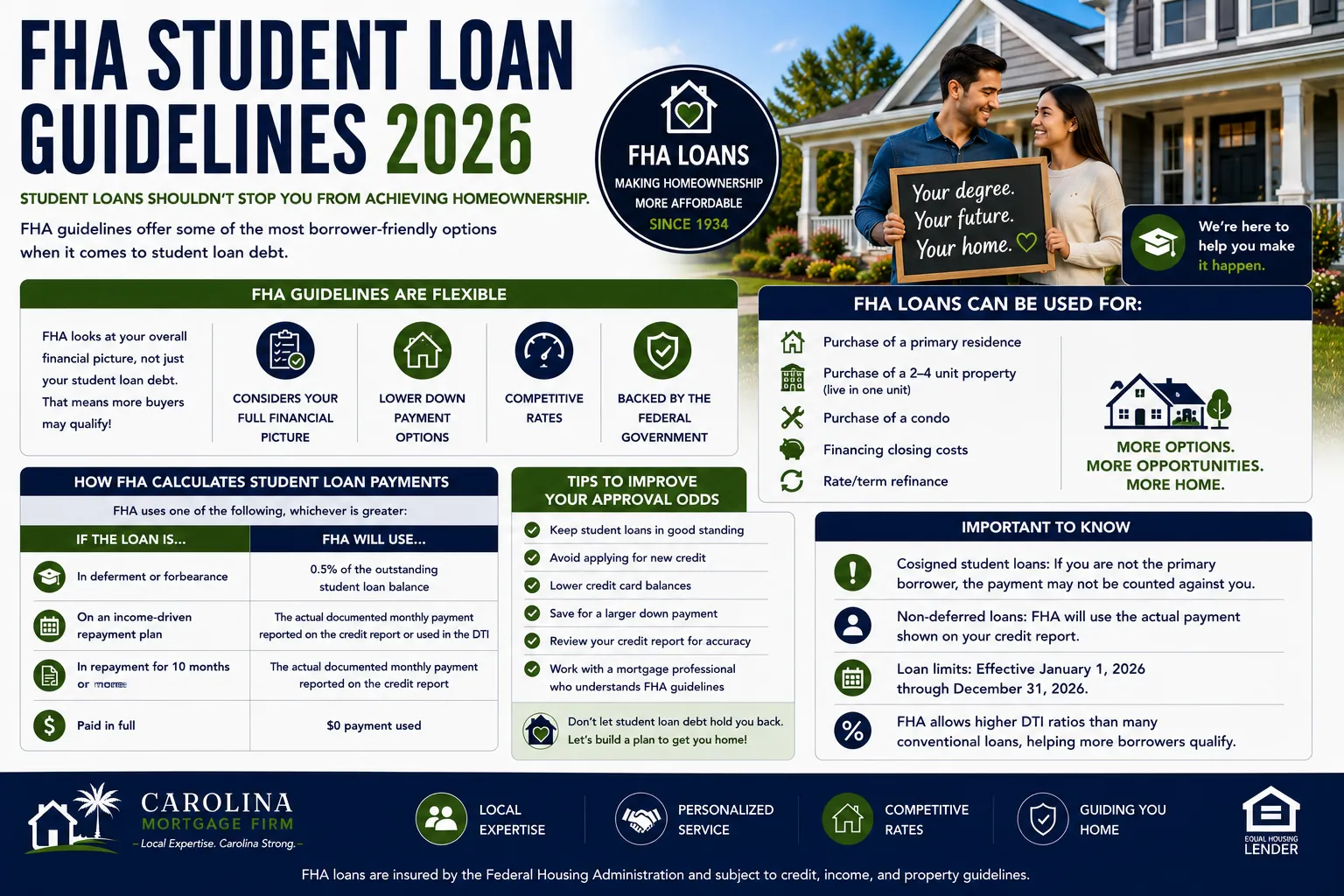
FHA requires lenders to account for student loan obligations when calculating your debt-to-income ratio (DTI).
In many situations, lenders may use:
The Actual Documented Payment
If a payment amount appears on the credit report or supporting documentation.
An Alternative Calculation Method
If the actual payment cannot be verified or is reported as zero.
Because guidelines can evolve and individual situations vary, a mortgage consultation is the best way to determine exactly how your student loans will be treated.
What Is Debt-to-Income Ratio (DTI)?
Student loans matter because they affect your debt-to-income ratio. DTI compares:
Your Monthly Debt Obligations
to
Your Gross Monthly Income
Examples of debts include:
- Student loans
- Car payments
- Credit cards
- Personal loans
- Child support
- Alimony
The lower your overall debt burden, the more flexibility you typically have when qualifying for a mortgage.
Why FHA Considers Student Loans
Some borrowers assume student loans should not count because:
- They’re deferred
- They’re income-based
- They’re not currently being paid
However, lenders must evaluate future obligations when determining affordability.
Because student loans represent a legal financial obligation, FHA requires them to be included in qualification calculations.
What If My Student Loans Are Deferred?
This is one of the most common FHA questions. Many borrowers believe:
“My loans are deferred, so they shouldn’t count.”
Unfortunately, deferred status does not automatically eliminate the obligation. FHA still requires lenders to account for student loan debt during qualification.
The calculation method depends on the documentation available and current FHA guidelines.
Many borrowers participate in:
- Income-Based Repayment (IBR)
- Income-Driven Repayment (IDR)
- SAVE Plans
- Other federal repayment programs
Sometimes these programs produce a documented payment of:
$0 per month
This creates understandable confusion among borrowers.
FHA guidelines provide methods for evaluating these situations.
Because treatment can vary based on documentation and guideline interpretation, individual review is important.
Can Student Loans Prevent Mortgage Approval?
Not necessarily.
Many borrowers with substantial student loan balances still qualify for FHA financing. What matters most is:
Monthly Payment Obligation
rather than
Total Loan Balance
For example:
Borrower A:
Student Loan Balance: $150,000 Monthly Payment: $150 Borrower B:
Student Loan Balance: $40,000 Monthly Payment: $700
Borrower B may actually experience a greater impact on qualification despite having a smaller balance.
This is why lenders focus heavily on monthly obligations.
FHA Loans Remain Popular for Student Loan Borrowers
Many buyers with student debt choose FHA financing because of its flexibility. Benefits include:
Lower Down Payment Requirements
As little as 3.5% down.
Flexible Credit Guidelines
FHA was designed to expand homeownership opportunities.
Higher Debt-to-Income Flexibility
Many borrowers qualify even with existing debt obligations.
First-Time Buyer Friendly
Ideal for younger professionals and recent graduates.
Common Borrowers Who Benefit
We frequently help:
Teachers Nurses Doctors Attorneys Engineers
Government Employees First-Time Homebuyers
Many of these professions involve student loan debt, yet homeownership remains achievable.
Common FHA Student Loan Myths
Myth #1: Student Loans Automatically Disqualify You
False.
Millions of homeowners have student loan debt.
Myth #2: You Must Pay Off Student Loans Before Buying
False.
Many buyers purchase homes while continuing repayment.
Myth #3: Deferred Loans Don’t Count
Not always.
FHA generally requires student loans to be considered.
Myth #4: FHA Is Only for Borrowers Without Debt
False.
FHA was specifically designed to help borrowers achieve homeownership despite financial obstacles.
How to Improve Mortgage Qualification With Student Loans
If you’re planning to buy a home, consider:
Maintaining Strong Credit
Credit scores affect loan options and pricing.
Avoiding New Debt
Additional obligations may impact DTI.
Building Savings
Stronger reserves create flexibility.
Providing Complete Documentation
Accurate student loan information helps avoid delays.
Getting Pre-Approved Early
Understanding your options before shopping is critical.
FHA vs Conventional Student Loan Treatment
Many borrowers compare FHA and Conventional financing.
FHA Loans
Often provide flexible qualification opportunities.
Conventional Loans
May offer different treatment depending on loan type and borrower profile.
Because every situation is unique, comparing multiple loan programs is often beneficial.
Why Pre-Approval Matters
Student loan borrowers should obtain a mortgage pre-approval before beginning their home search. Benefits include:
Understanding Affordability
Know what price range fits your budget.
Reviewing Student Loan Impact
See how payments affect qualification.
Comparing Loan Programs
Evaluate FHA, Conventional, VA, and USDA financing.
Avoiding Surprises
Address issues before finding a home.
Many buyers discover they qualify for more than they expected.
Why Work With Carolina Mortgage Firm?
At Carolina Mortgage Firm, we help buyers throughout:
- Charlotte
- Fort Mill
- Indian Land
- Rock Hill
- Lancaster
- Matthews
- Waxhaw
- Belmont
- Huntersville
- Concord
navigate FHA student loan guidelines and compare mortgage options. Because we work with multiple lenders, we can evaluate:
- FHA Loans
- Conventional Loans
- VA Loans
- USDA Loans
- Down Payment Assistance Programs
to identify the financing strategy that best fits your goals.
Frequently Asked Questions
Can I Get an FHA Loan With Student Loans?
Yes.
Do Deferred Student Loans Count?
Generally, FHA requires student loan obligations to be considered.
Does a Large Student Loan Balance Prevent Approval?
Not necessarily.
Can I Qualify With an Income-Based Repayment Plan?
Often yes.
Should I Pay Off My Student Loans Before Buying?
It depends on your overall financial picture.
Related FHA Resources
- What Credit Score Do I Need for an FHA Loan?
- FHA Down Payment Requirements
- FHA Gift Funds Requirements
- FHA Co-Borrower Guidelines
- FHA Bankruptcy Waiting Periods
Ready to Explore FHA Financing?
If you have student loan debt and want to understand your mortgage options, Carolina Mortgage Firm can help.
Whether you’re buying your first home in Charlotte, relocating to Fort Mill, purchasing in Indian Land, moving to Rock Hill, or searching throughout Lancaster County, our team can evaluate your situation and help create a personalized homeownership strategy.
Contact Carolina Mortgage Firm today for a personalized FHA eligibility review and mortgage pre-approval.