One of the most common questions homebuyers ask is:
“Should I choose an FHA loan or a Conventional loan?”
The answer depends on several factors, including your credit score, down payment, debt-to-income ratio, long-term financial goals, and how much money you have available for closing.
At Carolina Mortgage Firm, we help buyers throughout Charlotte, Fort Mill, Indian Land, Rock Hill, Lancaster, Waxhaw, Matthews, and surrounding communities compare both options every day.
While both programs can help you become a homeowner, each has distinct advantages and disadvantages. Understanding those differences can potentially save you thousands of dollars over the life of your mortgage.
What Is an FHA Loan?
An FHA loan is a government-backed mortgage insured by the Federal Housing Administration.
The FHA created this program to make homeownership more accessible for buyers who may not qualify for conventional financing.
Because the government provides insurance to lenders, FHA loans generally allow more flexible qualification guidelines.
FHA Loan Benefits
- Down payments as low as 3.5%
- Flexible credit requirements
- Higher debt-to-income ratio allowances
- Gift funds permitted
- Competitive interest rates
- Easier qualification for some first-time buyers
For many buyers who are rebuilding credit or have limited savings, FHA financing can be an excellent option.
What Is a Conventional Loan?
A conventional loan is not backed by a government agency.
Instead, it follows guidelines established by Fannie Mae and Freddie Mac.
Conventional financing is often preferred by buyers with stronger credit profiles because it can provide lower overall borrowing costs.
Conventional Loan Benefits
- Down payments as low as 3%
- Lower mortgage insurance costs for many borrowers
- No upfront mortgage insurance premium
- More flexibility for higher-income borrowers
- Potentially lower monthly payments
- Easier removal of mortgage insurance
For borrowers with strong credit, conventional financing is often the most cost-effective long-term solution.
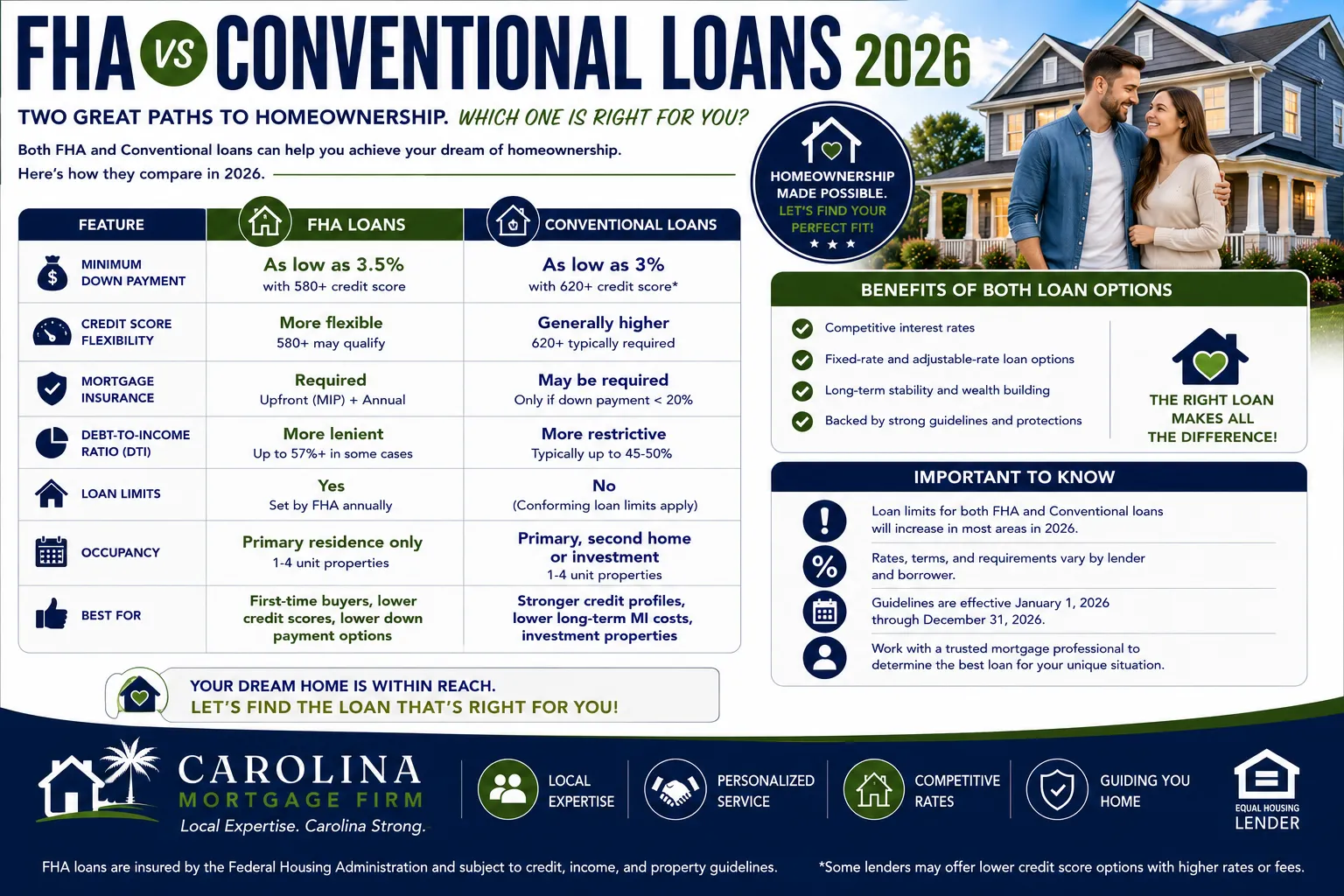
FHA vs. Conventional: Down Payment Requirements
Many buyers assume conventional loans require 20% down. That is one of the biggest myths in mortgage lending.
FHA Down Payment
Minimum down payment:
3.5%
Conventional Down Payment
Minimum down payment:
3%
While conventional loans technically require less money down, qualifying requirements are often stricter. This is why many first-time buyers still choose FHA financing.
FHA vs. Conventional: Credit Score Requirements
Credit score requirements vary by lender and loan program. However, FHA generally provides more flexibility.
FHA Loans
Typically more forgiving of:
- Lower credit scores
- Previous credit challenges
- Limited credit history Conventional Loans Generally reward:
- Strong credit profiles
- Established credit history
- Lower overall risk
Borrowers with credit scores above 700 frequently find conventional financing especially attractive.
FHA vs. Conventional: Mortgage Insurance
Mortgage insurance is one of the biggest differences between the two programs.
FHA Mortgage Insurance
FHA loans include:
Upfront Mortgage Insurance Premium (UFMIP)
This is typically financed into the loan amount.
Monthly Mortgage Insurance
Most FHA borrowers pay monthly mortgage insurance regardless of equity position. This insurance often remains in place for the life of the loan unless refinanced.
Conventional Mortgage Insurance
Conventional loans may require Private Mortgage Insurance (PMI) when putting less than 20% down. However:
- PMI is often less expensive than FHA mortgage insurance
- PMI can eventually be removed
- PMI automatically terminates at certain equity levels
This is one reason conventional financing frequently becomes the preferred choice for buyers with stronger credit.
FHA vs. Conventional: Debt-to-Income Ratios
Debt-to-income ratio (DTI) measures how much of your monthly income is allocated toward debt obligations.
FHA Flexibility
FHA often allows:
- Higher debt ratios
- More flexibility for first-time buyers
- Easier qualification for borrowers carrying student loans
Conventional Guidelines
Conventional financing may require:
- Lower overall debt levels
- Stronger compensating factors
- Better credit profiles
For buyers carrying significant student loan debt, FHA financing can sometimes provide additional flexibility.
FHA vs. Conventional: Property Requirements
FHA loans include property standards intended to ensure homes meet basic safety and livability requirements.
This can occasionally create challenges when purchasing:
- Older homes
- Properties requiring repairs
- Certain distressed properties
Conventional financing often provides greater flexibility regarding property condition.
In markets like Lancaster, Rock Hill, and older neighborhoods throughout Charlotte, this can become an important consideration.
Which Loan Has the Better Interest Rate?
Many buyers focus entirely on interest rates.
However, interest rate alone does not determine the overall cost of a mortgage. When comparing FHA and conventional financing, you should evaluate:
- Interest rate
- Monthly payment
- Mortgage insurance
- Total cash required
- Long-term ownership plans
In some situations, FHA rates may appear lower while producing higher overall costs because of mortgage insurance.
This is why a complete side-by-side analysis is important.
Which Loan Is Better for First-Time Homebuyers?
The answer depends on your specific situation.
FHA May Be Better If:
- Credit scores are lower
- Savings are limited
- Debt ratios are higher
- You need qualification flexibility
Conventional May Be Better If:
- Credit scores are strong
- You have stable income
- You plan to stay in the home long-term
- You want lower mortgage insurance costs
At Carolina Mortgage Firm, we frequently compare both options before making recommendations.
Example Scenario
Consider two buyers purchasing a $350,000 home. Buyer A:
- 640 credit score
- 3.5% down Buyer B:
- 760 credit score
- 5% down
Buyer A may benefit from FHA financing due to qualification flexibility. Buyer B may save thousands over time using conventional financing. This illustrates why there is no universal “best” loan program.
The right answer depends on the borrower.
Common FHA and Conventional Loan Myths
Myth #1: You Need 20% Down
False.
Many buyers purchase with 3% to 5% down.
Myth #2: FHA Is Only for First-Time Buyers
False.
Repeat buyers can use FHA financing.
Myth #3: Conventional Loans Always Have Better Rates
Not necessarily.
The total loan structure matters more than rate alone.
Myth #4: FHA Is Always Easier
Not always.
Certain property requirements can create additional hurdles.
Why Work With a Mortgage Broker?
One of the biggest advantages of working with a mortgage broker is having access to multiple lenders and loan programs.
Rather than forcing borrowers into a single solution, Carolina Mortgage Firm can compare:
- FHA Loans
- Conventional Loans
- VA Loans
- USDA Loans
- Jumbo Loans
- Specialty Programs
This allows us to identify the financing option that best aligns with your goals.
Frequently Asked Questions
Is FHA Easier to Qualify For?
Often yes, especially for borrowers with lower credit scores or higher debt ratios.
Can I Switch From FHA to Conventional Later?
Yes. Many homeowners refinance into conventional financing once equity increases.
Which Loan Requires Less Money Down?
Conventional loans may allow 3% down while FHA typically requires 3.5%.
Is Mortgage Insurance Permanent?
For FHA loans, it often remains longer than conventional PMI.
Which Loan Is Better?
The answer depends entirely on your financial profile and goals.
Internal Links
Link this article to:
- FHA Loans
- Conventional Loans
- First-Time Homebuyer Programs
- Mortgage Pre-Approval
- Down Payment Assistance Programs
- VA Loans
- USDA Loans
Ready to Compare FHA and Conventional Financing?
Whether you’re purchasing in Charlotte, Fort Mill, Indian Land, Rock Hill, Lancaster, Matthews, Waxhaw, or anywhere throughout North or South Carolina, Carolina Mortgage Firm can help you compare your options and determine which loan program best fits your needs.
Contact our team today for a personalized mortgage consultation and pre-approval.