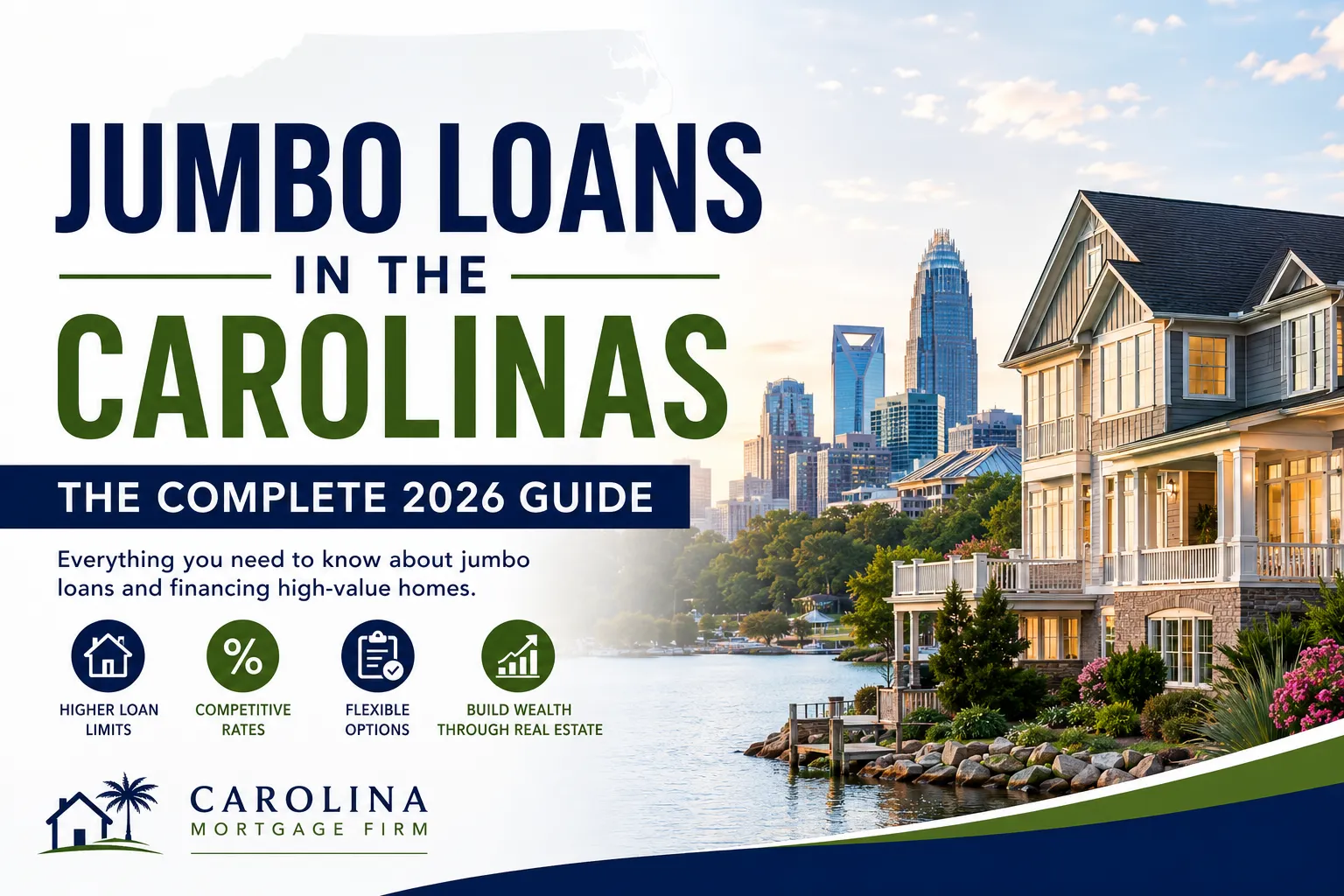
As home values continue to rise throughout North and South Carolina, more buyers are discovering they need financing that exceeds conventional loan limits.
Whether you’re purchasing a luxury home in Charlotte, a waterfront property on Lake Norman, an executive home in Fort Mill, or a custom-built residence in Indian Land, understanding jumbo financing is critical.
At Carolina Mortgage Firm, we work with buyers throughout the Carolinas who are often surprised to learn that qualifying for a jumbo loan isn’t as difficult as they expected.
In fact, today’s jumbo mortgage programs offer more flexibility than many people realize.
This guide will explain how jumbo loans work, who they are designed for, and how to determine whether jumbo financing is the right solution for your home purchase.
What Is a Jumbo Loan?
A jumbo loan is a mortgage that exceeds the conforming loan limits established by Fannie Mae and Freddie Mac.
Because these loans cannot be sold to conventional secondary markets in the same manner as conforming loans, lenders often have additional qualification requirements.
Jumbo financing is commonly used for:
- Luxury homes
- Executive residences
- Waterfront properties
- High-value primary residences
- Vacation homes
- Certain investment properties
As property values increase throughout the Charlotte Metro region and the Carolinas, jumbo financing has become increasingly common.
Where Jumbo Loans Are Common in the Carolinas
Many buyers assume jumbo loans are only for multi-million-dollar estates.
In reality, jumbo financing is becoming increasingly common in desirable housing markets. Popular jumbo loan markets include:
North Carolina
- Charlotte
- Lake Norman
- Weddington
- Marvin
- Waxhaw
- Davidson
- Cornelius
- Mooresville
South Carolina
- Fort Mill
- Indian Land
- Tega Cay
- Lake Wylie
- Greenville
- Charleston
- Hilton Head
As property values continue appreciating, more buyers are entering jumbo loan territory.
Benefits of Jumbo Loans
Higher Loan Amounts
Jumbo financing allows buyers to purchase homes above conventional loan limits.
Competitive Interest Rates
Many borrowers are surprised to discover jumbo rates can be highly competitive.
Flexible Loan Structures
Depending on the lender, options may include:
- Fixed-rate mortgages
- Adjustable-rate mortgages (ARMs)
- Interest-only options
- Second-home financing
Luxury Property Financing
Jumbo programs are specifically designed for higher-value homes.
Do Jumbo Loans Require 20% Down?
This is one of the biggest misconceptions about jumbo financing. Many buyers assume:
“I need 20% down for a jumbo loan.”
While larger down payments may provide advantages, many jumbo programs allow significantly less than 20% down depending on:
- Credit profile
- Loan amount
- Occupancy type
- Asset reserves
The exact requirements vary by lender.
A personalized mortgage consultation is the best way to determine available options.
Jumbo Loan Qualification Requirements
Although jumbo financing is more flexible than many buyers expect, lenders generally evaluate several key areas carefully.
Credit Scores
Stronger credit profiles typically receive:
- Better pricing
- More financing options
- Lower down payment requirements
Income Stability
Lenders review:
- Employment history
- Business ownership
- Variable income sources
- Bonus and commission earnings
Debt-to-Income Ratio
Debt obligations are evaluated relative to monthly income.
Asset Reserves
Many jumbo programs require borrowers to demonstrate additional reserves after closing.
What Are Asset Reserves?
Asset reserves are funds remaining after closing that demonstrate financial strength. Examples may include:
- Checking accounts
- Savings accounts
- Investment accounts
- Retirement accounts
Reserve requirements vary by lender and loan size.
For higher-balance loans, reserves often become an important qualification factor.
Jumbo Loans for Self-Employed Borrowers
Many business owners believe qualifying for a jumbo loan is impossible.
In reality, multiple options exist. Potential solutions include:
Traditional Income Documentation
Using tax returns and financial statements.
Bank Statement Loans
Evaluating income based on deposits and cash flow.
Alternative Documentation Programs
Designed specifically for entrepreneurs.
At Carolina Mortgage Firm, we frequently help successful business owners qualify for jumbo financing using alternative solutions.
Jumbo Loans vs Conventional Loans
Understanding the differences is important.
Conventional Loans
Pros:
Cons:
- Broad availability
- Familiar guidelines
- Lower loan amounts
- Limited by conforming loan limits
Jumbo Loans
Pros:
Cons:
- Higher loan amounts
- Luxury property financing
- Flexible options
- Additional underwriting requirements
The right solution depends entirely on your situation.
Fixed Rate vs Adjustable Rate Jumbo Loans
Many jumbo borrowers compare:
Fixed Rate Mortgages
Benefits:
- Stable monthly payment
- Long-term predictability
- Protection from future rate increases Adjustable Rate Mortgages (ARMs) Benefits:
- Lower initial rates
- Reduced early payments
- Flexibility for shorter ownership horizons
Buyers should carefully evaluate long-term goals before selecting a loan structure.
Common Jumbo Loan Myths
Myth #1: Jumbo Loans Are Only for Millionaires
False.
Many buyers purchasing moderately priced luxury homes require jumbo financing.
Myth #2: You Need 20% Down
Not necessarily.
Several programs allow lower down payments.
Myth #3: Jumbo Loans Have Extremely High Rates
Many jumbo rates remain highly competitive.
Myth #4: Self-Employed Borrowers Cannot Qualify
Numerous programs exist for entrepreneurs and business owners.
Why Pre-Approval Is Critical
Luxury markets move quickly.
Obtaining a jumbo pre-approval provides:
Clear Budget Understanding
Know exactly what price range makes sense.
Stronger Purchase Offers
Sellers prefer buyers with verified financing.
Confidence During Negotiations
Know your financing is already reviewed.
Faster Closings
Address potential issues early.
For buyers shopping in competitive luxury markets such as Lake Norman, Fort Mill, Weddington, and Indian Land, pre-approval is especially important.
Why Work With Carolina Mortgage Firm?
At Carolina Mortgage Firm, we help buyers throughout:
- Charlotte
- Fort Mill
- Indian Land
- Lake Norman
- Waxhaw
- Weddington
- Marvin
- Davidson
- Rock Hill
- Lancaster
navigate jumbo financing options.
Because we work with multiple lenders, we can compare:
- Jumbo Loans
- Conventional Loans
- Bank Statement Loans
- VA Loans
- New Construction Financing
- Investment Property Financing
This allows us to identify solutions tailored to your financial goals.
Frequently Asked Questions
What Is Considered a Jumbo Loan?
A mortgage that exceeds conforming loan limits.
Do Jumbo Loans Require Perfect Credit?
No, but stronger credit profiles generally receive better terms.
Can Self-Employed Borrowers Qualify?
Absolutely.
How Much Down Payment Is Required?
Requirements vary based on the borrower and lender.
Are Jumbo Rates Higher?
Not always. Many jumbo programs offer highly competitive pricing.
Internal Links
Link this article to:
- Mortgage Pre-Approval
- Bank Statement Loans
- New Construction Financing
- VA Loans
- Mortgage Rate Lock Strategies
- Investment Property Financing
Ready to Explore Jumbo Financing?
Whether you’re purchasing a luxury home in Charlotte, building a custom residence in Fort Mill, buying waterfront property on Lake Norman, or relocating to Indian Land, Carolina Mortgage Firm can help you navigate jumbo financing options and determine the best strategy for your purchase.
Contact our team today for a personalized jumbo mortgage consultation and pre-approval.