If you’re carrying student loan debt and wondering whether homeownership is possible, you’re not alone. One of the most common concerns we hear from prospective homebuyers is:
“Can I still buy a house if I have student loans?”
The answer is almost always:
Yes.
In fact, many homeowners throughout Charlotte, Fort Mill, Indian Land, Rock Hill, Lancaster, Matthews, Waxhaw, and surrounding communities successfully purchase homes while carrying student loan debt.
At Carolina Mortgage Firm, we help buyers understand how student loans impact mortgage qualification and identify financing solutions that support both their homeownership goals and long-term financial plans.
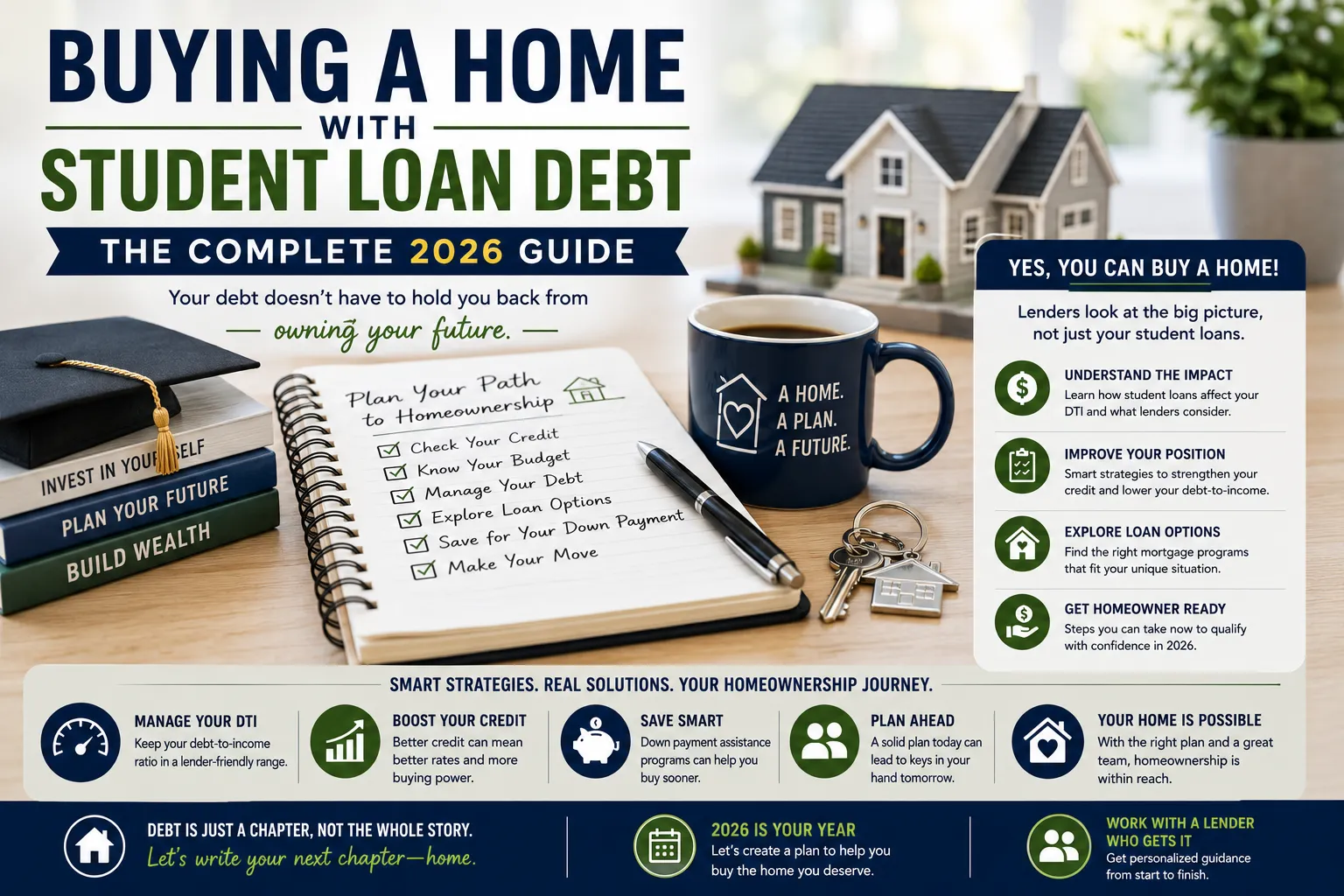
The presence of student loan debt does not automatically prevent homeownership. The key is understanding how lenders evaluate those obligations and how they fit into your overall financial profile.
Can You Get a Mortgage With Student Loan Debt?
Absolutely.
Most homebuyers today carry some form of student loan debt.
Mortgage lenders expect to see student loans and have established guidelines for evaluating them. The real question is not:
“Do you have student loans?”
The question is:
“How do those student loans affect your qualification?”
Lenders evaluate student loans similarly to other debts by considering how the payment impacts your overall debt-to-income ratio.
Why Student Loans Matter in Mortgage Qualification
Mortgage lenders calculate a borrower’s:
Debt-to-Income Ratio (DTI)
DTI compares your monthly debt obligations to your gross monthly income. Examples of debts include:
- Student loans
- Auto loans
- Credit cards
- Personal loans
- Child support
- Alimony
The lower your overall debt burden, the more flexibility you generally have when qualifying for a mortgage.
What If My Student Loans Are Deferred?
This is one of the most common questions homebuyers ask.
Many borrowers assume deferred loans won’t count toward qualification. Unfortunately, that’s not always the case.
Most mortgage programs require lenders to account for student loan obligations even when payments are currently deferred.
The calculation method varies by loan program.
This is one reason why working with a knowledgeable mortgage professional is so important.
FHA Student Loan Guidelines
FHA financing remains one of the most popular options for first-time buyers. One reason is FHA’s flexibility.
When evaluating student loans, FHA uses specific calculation methods to determine qualifying debt. Because guidelines evolve over time, borrowers should have their individual situation reviewed carefully. Benefits of FHA financing may include:
- Lower down payment requirements
- Flexible credit standards
- Higher debt-to-income ratio allowances
For many borrowers with student loan debt, FHA financing provides an excellent path to homeownership.
Conventional Loan Student Loan Guidelines
Conventional financing often offers attractive options for borrowers with strong credit profiles.
When evaluating student loan obligations, conventional lenders may use documented payment amounts or alternative calculation methods depending on the circumstances.
Benefits of conventional financing include:
- Competitive mortgage insurance options
- Low down payment programs
- Strong long-term affordability
Many buyers with student loan debt ultimately qualify through conventional financing.
Income-Driven Repayment Plans
Borrowers enrolled in:
- Income-Based Repayment (IBR)
- Income-Contingent Repayment (ICR)
- SAVE Plans
- Other income-driven repayment programs often have questions about qualification.
Mortgage lenders typically evaluate documented payment obligations according to program guidelines.
Understanding how your repayment plan affects qualification is an important part of the mortgage planning process.
How Student Loans Impact Purchasing Power
Let’s consider two buyers.
Buyer A
Income: $90,000
Student Loans: Minimal monthly payment Result: Potentially greater purchasing power.
Buyer B
Income: $90,000
Student Loans: Significant monthly obligation Result: Reduced affordability.
The key takeaway is that lenders focus on monthly obligations rather than total student loan balances alone.
A large balance does not automatically prevent qualification.
Common Myths About Student Loans and Mortgages
Myth #1: Student Loans Automatically Disqualify You
False.
Millions of homeowners carry student loan debt.
Myth #2: You Must Pay Off Student Loans First
False.
Many borrowers purchase homes while continuing student loan repayment.
Myth #3: FHA Is the Only Option
False.
Conventional, VA, USDA, and Jumbo financing may also be available.
Myth #4: Deferred Loans Don’t Matter
Not always.
Lenders generally must account for student loan obligations.
Should You Pay Off Student Loans Before Buying?
The answer depends on your overall financial picture. Paying off student loans may:
Help Qualification
Reducing monthly debt can improve DTI ratios.
Improve Affordability
Less debt often creates greater financial flexibility.
However, using all available savings to eliminate student loans may not always be the best strategy if it leaves insufficient funds for:
- Down payment
- Closing costs
- Emergency reserves
A mortgage consultation can help determine the best approach.
Loan Programs That May Help
Several mortgage options may work well for borrowers carrying student loan debt.
FHA Loans
Flexible qualification standards.
Conventional Loans
Competitive long-term financing.
VA Loans
Available to eligible veterans.
USDA Loans
Zero-down financing in eligible areas.
Choosing the right program depends on your individual circumstances.
Why Pre-Approval Matters
Buyers with student loans should obtain a pre-approval before shopping for homes. Benefits include:
Understanding Affordability
Know exactly what fits your budget.
Reviewing Student Loan Impact
Understand how lenders calculate qualification.
Comparing Programs
Evaluate FHA, Conventional, VA, and USDA options.
Avoiding Surprises
Address potential issues early.
At Carolina Mortgage Firm, many buyers discover they qualify for more than they expected.
Why Work With Carolina Mortgage Firm?
We help buyers throughout:
- Charlotte
- Fort Mill
- Indian Land
- Rock Hill
- Lancaster
- Waxhaw
- Matthews
- Belmont
- Concord
- Huntersville
navigate complex mortgage scenarios.
Because we work with multiple lenders, we can compare:
- FHA Loans
- Conventional Loans
- VA Loans
- USDA Loans
- Jumbo Loans
- Specialty Programs
to identify solutions tailored to your goals.
Frequently Asked Questions
Can I Buy a House With Student Loans?
Yes.
Do Deferred Student Loans Count?
Often yes, depending on the loan program.
What Debt-to-Income Ratio Is Allowed?
Requirements vary by loan type.
Is FHA Better for Student Loan Borrowers?
Sometimes, but not always.
Should I Pay Off My Student Loans Before Buying?
It depends on your overall financial situation.
Ready to Explore Your Homeownership Options?
Student loan debt does not have to prevent you from achieving homeownership.
Whether you’re purchasing in Charlotte, Fort Mill, Indian Land, Rock Hill, Lancaster, Matthews, Waxhaw, or elsewhere throughout the Carolinas, Carolina Mortgage Firm can help you understand your options and build a mortgage strategy that works for your financial goals.
Contact our team today for a personalized mortgage consultation and pre-approval.