If you’re planning to buy a home, refinance, or move up to a larger property, you’ve likely heard terms like:
- Conforming Loan
- Conventional Loan Limit
- High-Balance Loan
- Jumbo Loan
One of the most common questions we hear at Carolina Mortgage Firm is:
“What is the maximum conventional loan amount I can get?”
The answer depends on annual loan limits established by the federal government and the mortgage agencies that purchase conventional loans.
Understanding these limits is important because they affect:
- Down payment requirements
- Interest rates
- Loan options
- Qualification requirements
At Carolina Mortgage Firm, we help buyers throughout Charlotte, Fort Mill, Indian Land, Rock Hill, Lancaster, Matthews, Waxhaw, Belmont, Huntersville, and surrounding communities determine the best financing solution based on their purchase price and goals.
Let’s break down how conventional loan limits work and what they mean for homebuyers in the Carolinas.
Quick Answer: What Is a Conventional Loan Limit?
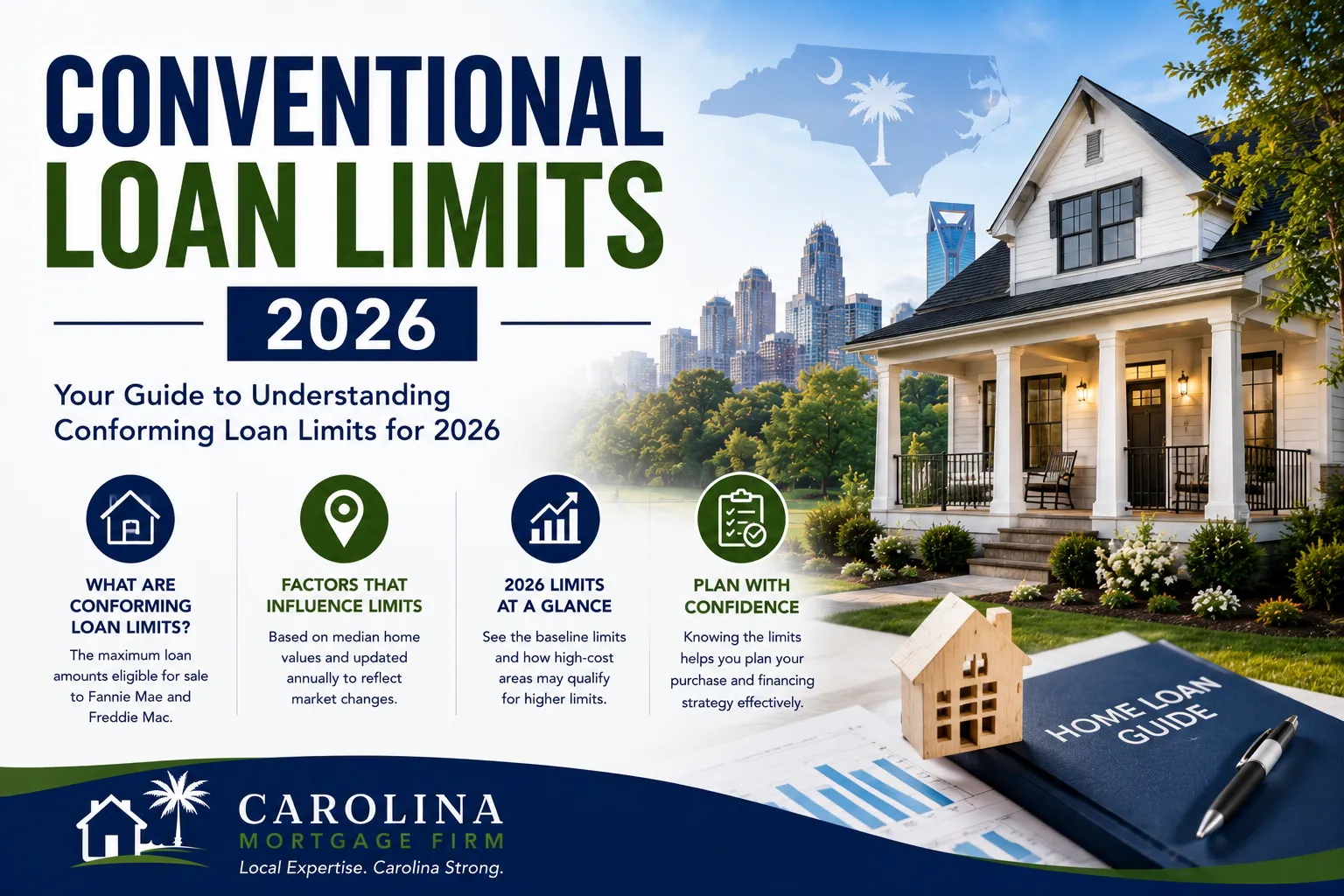
A conventional loan limit is the maximum loan amount that can be purchased by:
- entity[“organization”,”Fannie Mae”,”Government-sponsored enterprise”]
- entity[“organization”,”Freddie Mac”,”Government-sponsored enterprise”] Loans that fall within these limits are called:
Conforming Loans
Loans that exceed these limits are generally considered:
Jumbo Loans
Because conforming loans are easier to sell in the secondary mortgage market, they often offer more favorable financing options.
What Is a Conforming Loan?
A conforming loan is a conventional mortgage that meets the underwriting and loan amount guidelines established by Fannie Mae and Freddie Mac.
Benefits often include:
Competitive Interest Rates Lower Down Payment Options Flexible Loan Terms
Most homebuyers use conforming conventional financing.
Why Do Conventional Loan Limits Exist?
Loan limits help create consistency throughout the mortgage industry. The limits are designed to:
Support Homeownership Promote Mortgage Liquidity Manage Lending Risk
Because home values change over time, conforming loan limits are periodically adjusted.
How Are Conventional Loan Limits Determined?
Each year, federal housing agencies review:
- Home price appreciation
- Housing market data
- Economic conditions
Based on these factors, loan limits may increase or remain unchanged.
This allows conventional financing to keep pace with changing housing markets.
What Happens If I Exceed the Conventional Loan Limit?
If your loan amount exceeds conforming loan limits, you may need:
Jumbo Financing
Jumbo loans are designed for higher-priced properties and larger loan amounts. While jumbo loans offer excellent financing solutions, they may have:
Different Credit Requirements Larger Reserve Requirements
Additional Documentation Requirements Different Down Payment Expectations
Not every high-priced home requires a jumbo loan, however.
A larger down payment can sometimes keep the loan amount within conforming limits.
Conventional Loan Limits in the Charlotte Metro Area
Many Carolina Mortgage Firm clients purchase homes throughout:
North Carolina
- Mecklenburg County
- Union County
- Cabarrus County
- Gaston County
- Lincoln County
- Iredell County
South Carolina
- York County
- Lancaster County
- Chester County
For most of these markets, standard conforming loan limits apply.
However, because limits can change periodically, buyers should verify current limits before making financing decisions.
How Loan Limits Affect Your Down Payment
Many buyers assume loan limits restrict home prices. This isn’t necessarily true.
Loan limits restrict:
Loan Amount
not
Purchase Price
For example:
If the conforming loan limit is exceeded, a borrower may still purchase the home by:
Increasing Down Payment
This can reduce the loan amount and potentially avoid jumbo financing.
Conventional Loan Limits vs FHA Loan Limits
This is one of the most common points of confusion.
Conventional Loan Limits
Apply to Fannie Mae and Freddie Mac financing.
FHA Loan Limits
Apply to FHA-insured mortgages.
The two programs often have different limits and qualification requirements. Because both options may be available, comparing programs is important.
Conventional Loan Limits for Multi-Unit Properties
Loan limits are generally higher for:
Duplexes Triplexes Fourplexes
This creates opportunities for:
- Investors
- House hackers
- Multi-generational households
Multi-unit properties often qualify for larger conforming loan amounts than single-family homes.
Who Benefits Most From Conventional Financing?
Conventional loans are popular among:
First-Time Homebuyers Move-Up Buyers Repeat Homeowners Investors
High-Income Borrowers Buyers With Strong Credit
Because conventional financing offers flexibility and competitive pricing, it remains one of the most commonly used mortgage options.
Common Conventional Loan Limit Myths
Myth #1: Loan Limits Restrict Home Prices
False.
They restrict loan amounts, not purchase prices.
Myth #2: Every Large Mortgage Is a Jumbo Loan
False.
A larger down payment may keep financing within conforming limits.
Myth #3: Conventional and FHA Limits Are Identical
False.
They are separate programs with separate limits.
Myth #4: Loan Limits Never Change
False.
They may be adjusted periodically based on housing market conditions.
Should I Choose Conventional or Jumbo Financing?
The answer depends on:
Purchase Price Down Payment Credit Profile Assets
In some situations, conventional financing may provide advantages. In others, jumbo financing may be the better solution.
A mortgage consultation can help determine the optimal strategy.
Why Pre-Approval Matters
Understanding loan limits before house hunting can save significant time. Benefits of pre-approval include:
Understanding Purchasing Power Comparing Loan Programs Identifying Jumbo Thresholds Creating a Financing Strategy Strengthening Offers
Many buyers discover they have more options than expected.
Why Work With Carolina Mortgage Firm?
At Carolina Mortgage Firm, we help buyers throughout:
- Charlotte
- Fort Mill
- Indian Land
- Rock Hill
- Lancaster
- Matthews
- Waxhaw
- Belmont
- Huntersville
- Concord
understand conventional financing options and loan limits. Because we work with multiple lenders, we can compare:
- Conventional Loans
- FHA Loans
- VA Loans
- USDA Loans
- Jumbo Loans
- Investment Property Financing
to identify the best mortgage solution for your goals.
Frequently Asked Questions
What Is a Conventional Loan Limit?
The maximum loan amount eligible for conforming financing.
What Happens If I Exceed the Limit?
Jumbo financing may be required.
Can I Avoid a Jumbo Loan?
Sometimes by increasing your down payment.
Are Conventional Limits Different From FHA Limits?
Yes.
Should I Get Pre-Approved Before House Hunting?
Absolutely.
Related Conventional Resources
- What Credit Score Is Needed for a Conventional Loan?
- Can I Buy a Home With 3% Down?
- Can Bonus Income Be Used to Qualify?
- Can Commission Income Be Used for a Mortgage?
- How Much Reserve Funds Do I Need for a Conventional Loan?
Ready to Explore Your Financing Options?
Whether you’re buying your first home in Charlotte, moving to Fort Mill, purchasing in Indian Land, relocating to Rock Hill, or shopping for a luxury property in Lancaster County, Carolina Mortgage Firm can help you understand conventional loan limits and identify the right financing solution.
Contact Carolina Mortgage Firm today for a personalized mortgage consultation and pre-approval.