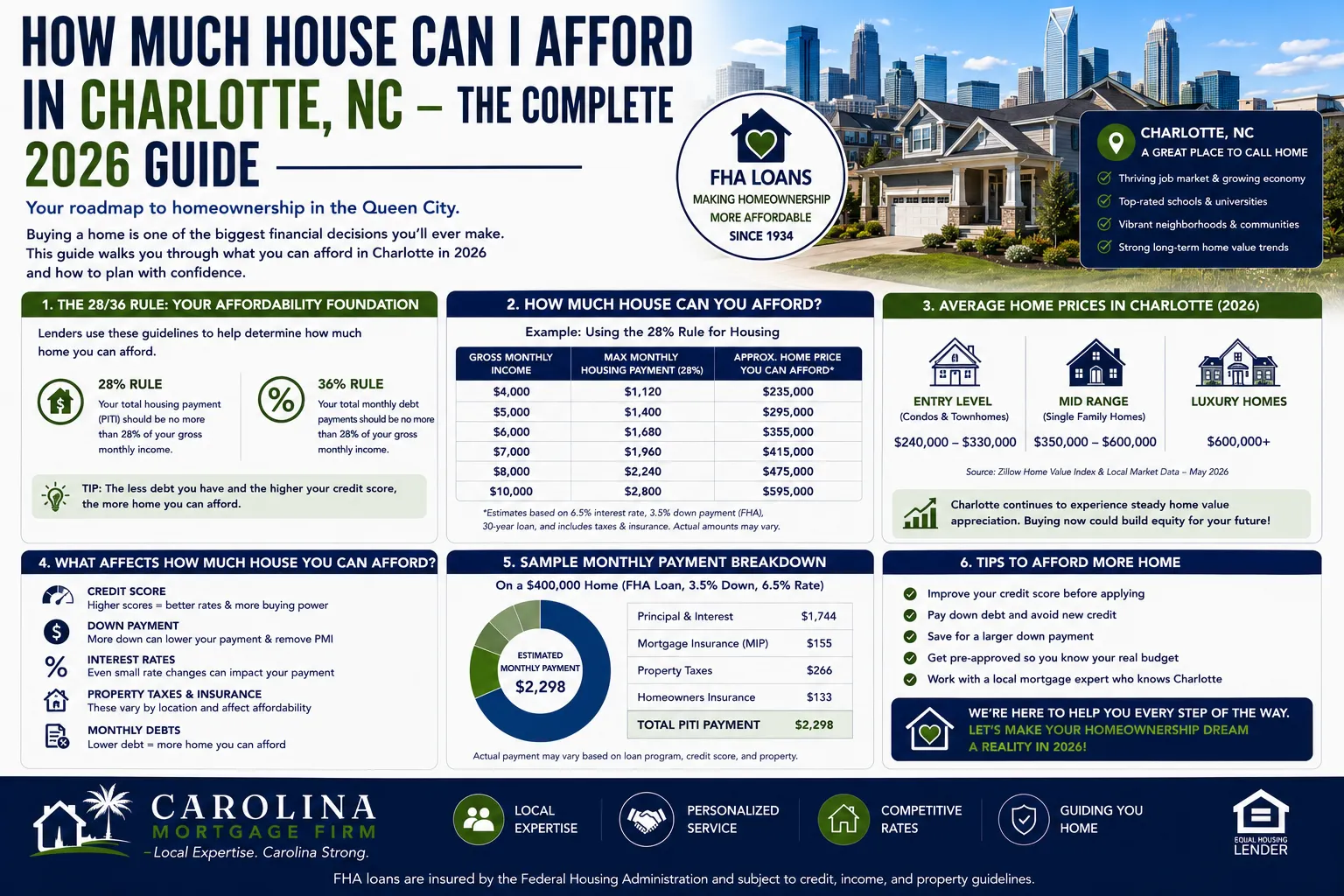
One of the first questions most homebuyers ask is:
“How much house can I afford?”
While online mortgage calculators can provide rough estimates, they rarely tell the whole story.
The amount a lender may approve you for and the amount you should comfortably spend are often two very different numbers.
At Carolina Mortgage Firm, we help buyers throughout Charlotte, Fort Mill, Indian Land, Rock Hill, Lancaster, Matthews, Waxhaw, Belmont, and surrounding communities determine a homebuying budget that supports both their homeownership goals and long-term financial success.
Understanding affordability before you begin shopping can save time, reduce stress, and help you make a smarter purchasing decision.
The Difference Between “Can Afford” and “Should Afford”
Many buyers focus on the maximum amount a lender will approve. While that’s important information, it shouldn’t be the only factor. For example:
A lender may approve a buyer for a $500,000 home.
However, that buyer may feel more comfortable purchasing a $425,000 home because it leaves room for:
- Travel
- Retirement savings
- Children’s activities
- Emergency funds
- Future investments
The goal is not simply obtaining the largest mortgage possible. The goal is creating a sustainable financial plan.
Factors That Determine Affordability
Several factors influence how much home you may qualify for.
Income
Your income is one of the largest factors. Examples include:
- Salary income
- Hourly income
- Commission income
- Bonus income
- Self-employed income
- Retirement income
Lenders evaluate stable, documented income when determining qualification.
Monthly Debts
Lenders review existing obligations such as:
- Auto loans
- Student loans
- Credit cards
- Personal loans
- Child support
- Other monthly obligations
These debts directly impact qualification.
Credit Score
Your credit score affects:
- Interest rates
- Loan options
- Monthly payments
- Overall affordability
Higher credit scores often result in better financing terms.
Down Payment
Your down payment impacts:
- Loan amount
- Monthly payment
- Mortgage insurance
- Loan program eligibility
Many buyers are surprised to learn they may not need 20% down.
Understanding Debt-to-Income Ratio (DTI)
One of the most important affordability calculations is your Debt-to-Income Ratio. DTI compares your monthly debts to your gross monthly income.
For example:
Monthly Income: $8,000 Monthly Debts: $800 Housing Payment: $2,200 Total Monthly Debt: $3,000 DTI: 37.5%
Different loan programs allow different DTI levels.
Understanding this number is critical when determining affordability.
What Makes Up a Mortgage Payment?
Many buyers only consider principal and interest. However, a complete housing payment often includes:
Principal
Repayment of the loan balance.
Interest
Cost of borrowing money.
Property Taxes
Based on local tax assessments.
Homeowners Insurance
Protects the property against covered losses.
Mortgage Insurance
May apply depending on loan type and down payment.
HOA Dues
Applicable in many communities.
When evaluating affordability, all of these costs should be considered.
Property Taxes Matter More Than You Think
One reason buyers compare Charlotte, Fort Mill, and Indian Land is property taxes.
Charlotte, NC
Property taxes are generally higher than many nearby South Carolina communities.
Fort Mill & Indian Land, SC
South Carolina owner-occupied properties often benefit from lower tax burdens. This can significantly affect monthly affordability.
Two homes with identical sales prices may produce very different monthly payments based on taxes alone.
How Much Income Do You Need?
Many buyers assume they need six-figure incomes to purchase a home. The reality depends on:
- Purchase price
- Down payment
- Debt obligations
- Interest rate
- Property taxes
A personalized mortgage consultation provides much more accurate guidance than general rules of thumb.
Affordability Examples
Example 1: First-Time Buyer
Income: $85,000 Down Payment: 5% Existing Debt: Minimal
Potential Result: May qualify for a home significantly above what many first-time buyers expect.
Example 2: Move-Up Buyer
Income: $150,000
Current Home Equity: $100,000+ Existing Mortgage: Being sold
Potential Result: Substantially increased purchasing power.
Example 3: Self-Employed Borrower
Income Qualification: May depend on tax returns, bank statements, or other documentation.
This is why self-employed buyers should obtain guidance early.
Common Affordability Mistakes
Focusing Only on the Purchase Price
Monthly payment matters more than the sales price alone.
Ignoring Future Goals
Retirement savings and emergency funds should remain priorities.
Shopping Before Pre-Approval
Many buyers fall in love with homes before understanding their budget.
Assuming You Need 20% Down
Numerous programs allow substantially less.
Why Pre-Approval Is Essential
A mortgage pre-approval provides:
Accurate Budget Information
Know exactly what price range makes sense.
Confidence While Shopping
Avoid uncertainty.
Stronger Purchase Offers
Sellers prefer pre-approved buyers.
Faster Closings
Financing review begins earlier.
At Carolina Mortgage Firm, many clients are surprised by what they qualify for once a full review is completed.
How Carolina Mortgage Firm Helps Buyers
We help buyers throughout:
- Charlotte
- Fort Mill
- Indian Land
- Rock Hill
- Lancaster
- Matthews
- Waxhaw
- Belmont
- Concord
- Huntersville
compare loan programs and determine a realistic homebuying budget. We evaluate:
- FHA Loans
- Conventional Loans
- VA Loans
- USDA Loans
- Jumbo Loans
- Bank Statement Loans
to identify the financing strategy that best supports your goals.
Frequently Asked Questions
How Much House Can I Afford?
The answer depends on income, debts, credit profile, down payment, and loan program.
Should I Buy at My Maximum Approval Amount?
Not necessarily.
Many buyers choose to remain below their maximum approval level.
Do I Need 20% Down?
No.
Many programs allow much smaller down payments.
Can Student Loans Affect Affordability?
Yes.
However, many buyers still qualify despite student loan debt.
How Do I Find Out My Budget?
The best first step is obtaining a mortgage pre-approval.
Internal Links
Link this article to:
- Mortgage Pre-Approval Guide
- FHA vs Conventional Loans
- First-Time Homebuyer Programs
- Down Payment Assistance Programs
- Mortgage Broker vs Bank
- Moving From Renting to Owning
Ready to Find Out What You Can Afford?
Whether you’re buying your first home in Charlotte, upgrading in Fort Mill, relocating to Indian Land, or searching in Rock Hill or Lancaster, Carolina Mortgage Firm can help you understand your budget and explore your financing options.
Contact our team today for a personalized mortgage consultation and pre-approval.