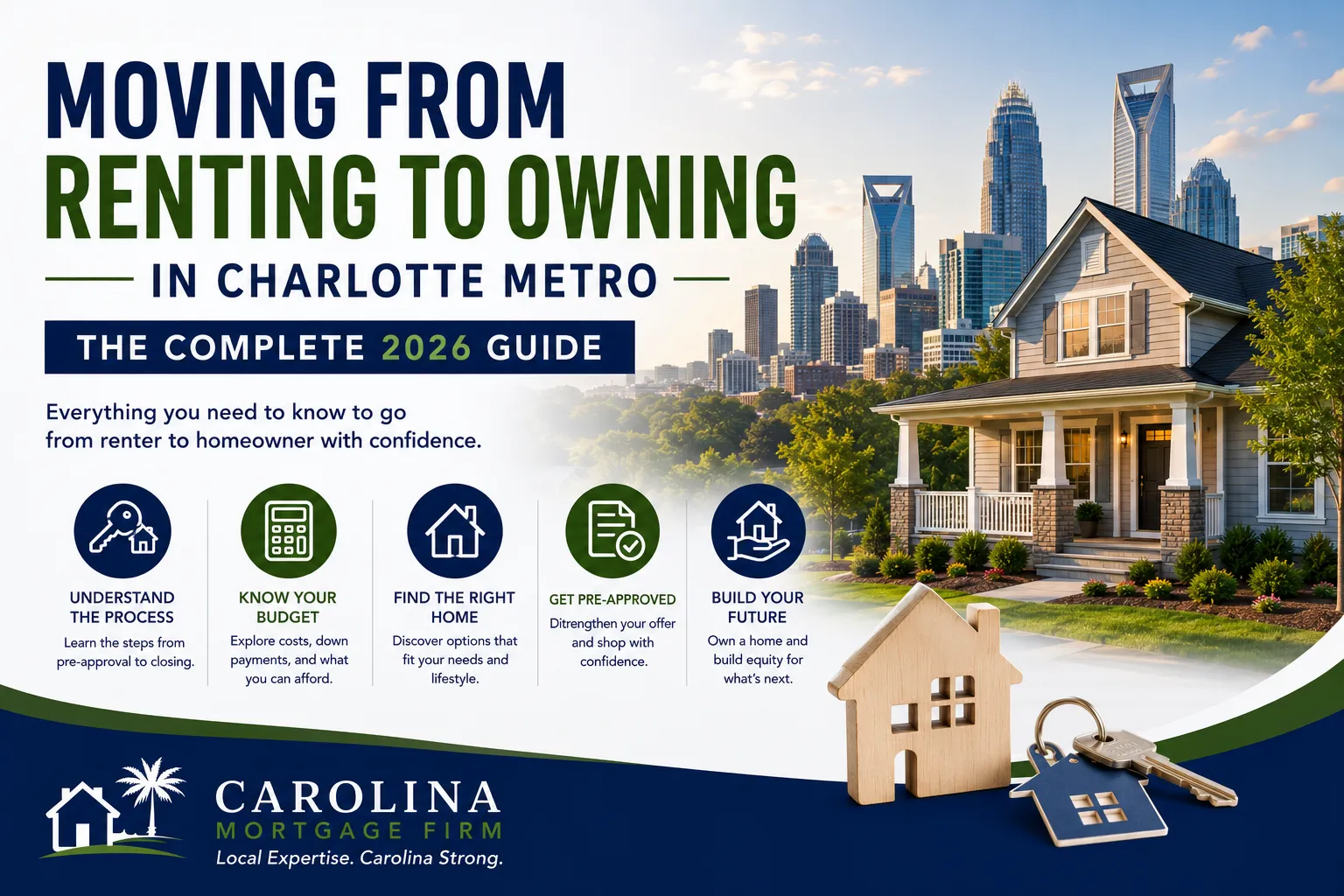
For many residents throughout the Charlotte Metro area, the question isn’t whether they want to own a home someday.
The question is:
“Does buying a home make sense for me right now?”
With rising rental costs, increasing home values, and changing interest rates, many renters throughout Charlotte, Fort Mill, Indian Land, Rock Hill, Lancaster, Matthews, Waxhaw, and surrounding communities are evaluating whether homeownership may be a better long-term financial decision.
The truth is that buying a home isn’t the right decision for everyone. However, many renters are surprised to discover they are much closer to homeownership than they realize.
Understanding the differences between renting and owning can help you make an informed decision about your future.
The Current Charlotte Metro Housing Market
The Charlotte Metro area continues to be one of the fastest-growing regions in the Southeast. Communities such as:
- Charlotte
- Fort Mill
- Indian Land
- Rock Hill
- Lancaster
- Waxhaw
- Matthews
- Huntersville
- Belmont
- Concord
continue attracting buyers from across the country due to strong job growth, quality schools, lower taxes in certain areas, and an exceptional quality of life.
As demand has increased, rental prices have also continued to rise. Many renters are finding themselves asking an important question: “If I’m already paying this much in rent, could I own instead?” The answer may be yes.
The Biggest Myth About Homeownership
One of the most common statements we hear is:
“I can’t afford to buy a house.”
However, many renters are basing that conclusion on outdated information. Common misconceptions include:
- I need 20% down.
- My credit isn’t good enough.
- Closing costs are too expensive.
- The process is too complicated.
- Renting is always cheaper.
In reality, many buyers purchase homes with significantly less money down than they expected.
Renting: The Advantages
Renting offers several benefits.
Flexibility
Leases generally allow easier relocation.
Lower Maintenance Responsibility
Major repairs are typically handled by the property owner.
Lower Upfront Costs
Renting often requires less money upfront than purchasing.
Short-Term Housing Needs
If you plan to relocate within a year or two, renting may make more sense.
For some individuals, renting remains the right choice.
Renting: The Disadvantages
While renting offers flexibility, it also has drawbacks.
No Equity Building
Monthly rent payments do not build ownership.
Increasing Rent Payments
Rental rates often increase over time.
Limited Control
Restrictions may apply regarding:
- Pets
- Renovations
- Decorating
- Property use
Less Long-Term Stability
Lease renewals and rent increases can create uncertainty.
Many renters eventually reach a point where they desire more control and stability.
Owning: The Advantages
Homeownership provides benefits that renting cannot.
Building Equity
Each mortgage payment helps increase ownership in your home.
Fixed Housing Payments
With a fixed-rate mortgage, principal and interest payments remain stable.
Long-Term Wealth Building
Historically, homeownership has been one of the primary ways families build wealth.
Freedom to Personalize
Homeowners can customize their property to fit their needs.
Greater Stability
Ownership provides more control over your living situation.
For many families, these advantages outweigh the flexibility of renting.
How Much Money Do You Really Need?
This is often the biggest surprise for renters. Many buyers believe they need:
- $50,000 down
- Perfect credit
- Years of savings
In reality, many loan programs require substantially less.
Conventional Loans
May allow as little as 3% down.
FHA Loans
Require as little as 3.5% down.
VA Loans
Eligible veterans may purchase with no down payment.
USDA Loans
Qualified rural properties may be eligible for zero-down financing.
The amount needed varies based on your specific situation, but it is often much less than renters expect.
Understanding the Monthly Payment Difference
When comparing renting versus owning, many buyers focus solely on the mortgage payment. A true comparison should include:
Homeownership Costs
- Principal
- Interest
- Property Taxes
- Homeowners Insurance
- HOA Dues (if applicable)
Rental Costs
- Monthly Rent
- Annual Rent Increases
- Lack of Equity Growth
The goal isn’t simply to compare payments.
The goal is understanding the long-term financial impact of each option.
Why Pre-Approval Is the First Step
Many renters spend months browsing homes online before speaking with a mortgage professional. This is backwards.
Obtaining a pre-approval first helps you:
Understand Your Budget
Know exactly what price range fits your goals.
Identify Loan Programs
Learn which mortgage options are available.
Understand Cash Requirements
Determine how much money you’ll need.
Develop a Plan
Even if you’re not ready today, you can create a roadmap toward ownership.
At Carolina Mortgage Firm, many clients begin the process six to twelve months before purchasing.
Common Reasons Renters Delay Buying
Fear of Rejection
Many renters assume they won’t qualify.
Misunderstanding Credit Requirements
Mortgage options exist for a wide range of credit profiles.
Waiting for the “Perfect Time”
Trying to perfectly time the market is difficult.
Lack of Information
Many renters simply haven’t spoken with a mortgage professional.
These concerns are understandable but often unnecessary.
Real Example: Charlotte vs. Fort Mill
Consider two renters paying $2,300 per month. One rents an apartment in Charlotte.
The other rents a townhome in Fort Mill.
After reviewing their finances, both discover they qualify to purchase homes with monthly payments similar to their current rent.
The difference?
Their mortgage payments help build equity rather than simply paying a landlord.
While every situation is different, examples like this occur regularly throughout the Charlotte Metro area.
Why Work With Carolina Mortgage Firm?
At Carolina Mortgage Firm, we specialize in helping renters become homeowners. We serve buyers throughout:
- Charlotte
- Fort Mill
- Indian Land
- Rock Hill
- Lancaster
- Matthews
- Waxhaw
- Belmont
- Huntersville
- Concord
Our team helps clients:
- Understand loan options
- Compare FHA and Conventional financing
- Explore down payment assistance programs
- Obtain pre-approvals
- Create customized homeownership strategies
Our goal is to simplify the process and help buyers make confident financial decisions.
Frequently Asked Questions
Do I Need 20% Down?
No. Many buyers purchase with far less.
Can I Buy With Student Loan Debt?
Often yes.
What Credit Score Is Needed?
Requirements vary by program, but many options exist.
Should I Keep Renting Until Rates Drop?
That depends on your goals, finances, and housing needs.
How Do I Know If I’m Ready?
A mortgage consultation is the best way to determine readiness.
Internal Links
Link this article to:
- First-Time Homebuyer Programs
- FHA Loans
- Conventional Loans
- Down Payment Assistance Programs
- Mortgage Pre-Approval
- Home Affordability Calculator
- VA Loans
Ready to Stop Renting and Start Building Equity?
Whether you’re renting in Charlotte, Fort Mill, Indian Land, Rock Hill, Lancaster, Matthews, Waxhaw, or elsewhere throughout the Carolinas, Carolina Mortgage Firm can help you evaluate your options and determine whether homeownership makes sense for you.
Contact our team today for a personalized mortgage consultation and pre-approval. You may be closer to owning a home than you think.