When you’re preparing to buy a home, one of the first decisions you’ll make is where to get your mortgage. For many buyers, the choice comes down to two options:
A Mortgage Broker or A Bank
At first glance, they may seem similar. Both can help you obtain a mortgage and purchase a home. However, the way they operate—and the options they can provide—are often very different.
For buyers throughout Charlotte, Fort Mill, Indian Land, Rock Hill, Lancaster, Waxhaw, Matthews, and surrounding communities, understanding these differences can potentially save thousands of dollars and help ensure you choose the financing solution that best fits your needs.
Let’s break down how each option works and what you should consider before making a decision.
What Is a Mortgage Broker?
A mortgage broker acts as an independent mortgage advisor who works with multiple lenders.
Rather than offering only one lender’s products, a broker shops among various wholesale lenders to help identify financing options that fit a borrower’s goals.
Think of a mortgage broker as similar to an insurance broker.
An insurance broker compares policies from multiple companies.
A mortgage broker compares loan programs from multiple lenders.
At Carolina Mortgage Firm, we work with numerous lending partners, allowing us to compare:
- Conventional Loans
- FHA Loans
- VA Loans
- USDA Loans
- Jumbo Loans
- Bank Statement Loans
- Investment Property Financing
- Specialty Mortgage Programs
This flexibility often creates opportunities that may not be available through a single institution.
What Is a Bank?
A bank offers mortgage products directly to consumers. Examples include:
- National banks
- Regional banks
- Local community banks
- Credit unions
Banks generally lend their own products or products available within their specific institution.
While some banks offer excellent mortgage solutions, borrowers are typically limited to that bank’s available programs.
This means you’re evaluating one lender’s offerings rather than multiple lenders at the same time.
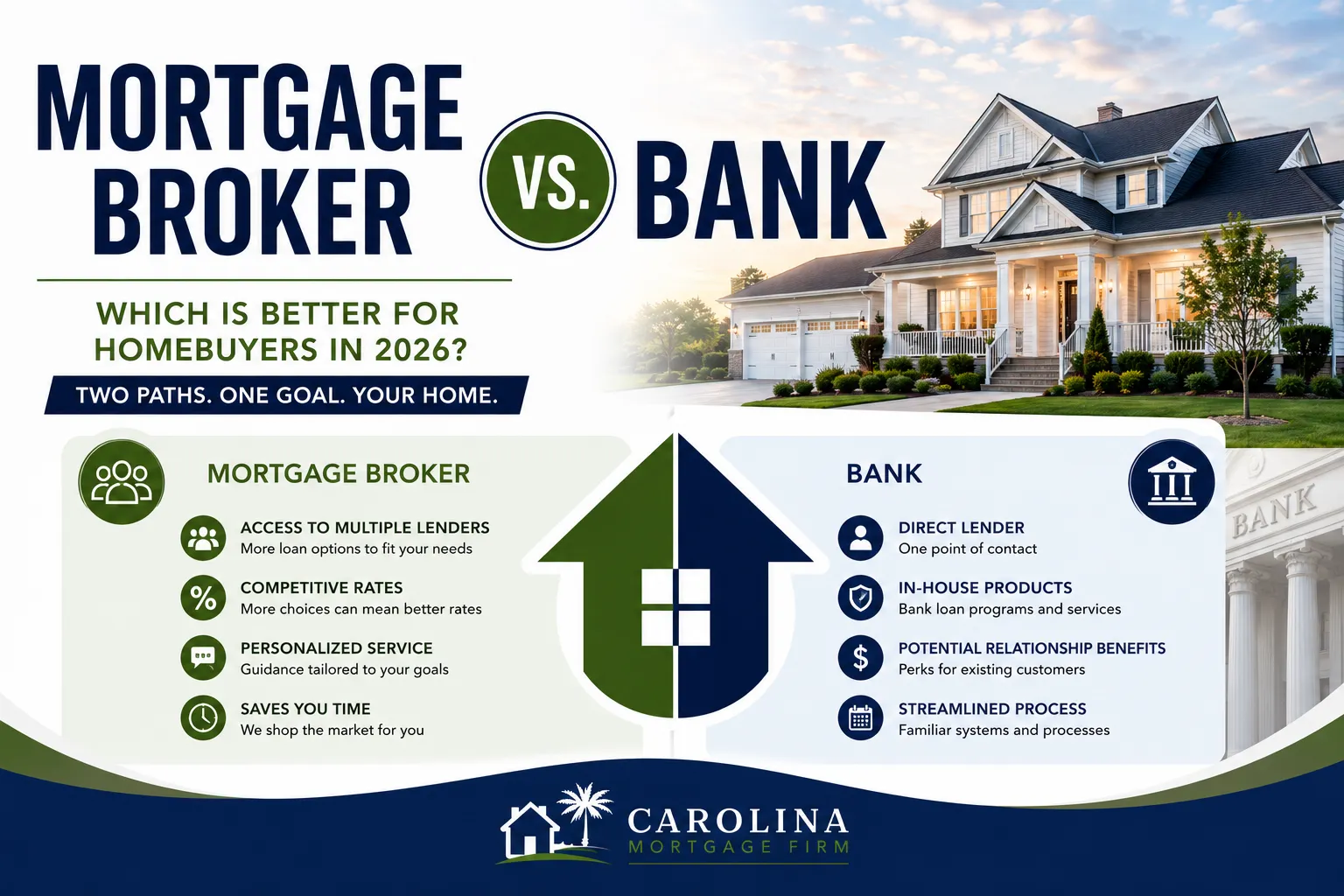
The Biggest Difference: Options
The largest difference between a broker and a bank is simple:
Banks Offer Their Products
Brokers Offer Multiple Lenders’ Products
Imagine shopping for a vehicle.
Would you rather:
- Visit one dealership and see one brand?
Or
- Visit a marketplace where multiple brands compete for your business? Mortgage shopping works much the same way.
More options often create more opportunities.
Why Homebuyers Choose Mortgage Brokers
Access to Multiple Lenders
One of the biggest advantages of working with a broker is access.
Instead of comparing lenders yourself, a broker can often compare programs on your behalf.
More Loan Options
Every lender has different strengths. One lender may excel with:
- First-time homebuyers Another may specialize in:
- Self-employed borrowers Another may offer:
- Better jumbo financing
A broker can help identify which lender best fits your situation.
Competitive Pricing
Because lenders compete for business through brokers, borrowers often benefit from competitive pricing structures.
Specialized Programs
Many niche loan products are more readily available through wholesale lending channels.
Examples include:
- Bank Statement Loans
- DSCR Loans
- Investor Financing
- Non-QM Loans
Why Some Buyers Choose Banks
Banks also offer advantages.
Existing Relationship
Many borrowers like working with a financial institution they already know.
One Location for Banking
Checking accounts, savings accounts, and mortgage financing may all be housed under one roof.
Local Branch Access
Some buyers appreciate face-to-face branch availability.
For certain borrowers, these benefits may outweigh the advantages of broader lender access.
Mortgage Broker vs Bank: Rate Comparison
One of the biggest misconceptions in the mortgage industry is:
“Banks always have the lowest rates.”
The truth is more nuanced. Mortgage rates vary based on:
- Credit score
- Down payment
- Occupancy type
- Loan amount
- Market conditions
Some days a bank may offer the better rate.
Other days a wholesale lender may provide a better option.
This is why comparison shopping remains important. The goal isn’t finding the lowest advertised rate.
The goal is identifying the best overall loan structure.
Mortgage Broker vs Bank: First-Time Homebuyers
First-time buyers often benefit from working with a broker because multiple programs can be compared simultaneously.
Examples include:
- FHA Financing
- Conventional Financing
- Down Payment Assistance
- USDA Financing
- State Housing Programs
A broker can evaluate several possibilities before making a recommendation.
Mortgage Broker vs Bank: Self-Employed Borrowers
Self-employed borrowers frequently face unique challenges. Business owners often:
- Write off expenses
- Have fluctuating income
- Use multiple income sources
Many traditional banks have limited flexibility.
Mortgage brokers often have access to lenders specializing in:
- Bank Statement Loans
- Asset-Based Financing
- Alternative Documentation Programs
This can create opportunities unavailable through traditional channels.
Mortgage Broker vs Bank: VA Loans
Veterans deserve to maximize their earned benefits.
Mortgage brokers can often compare multiple VA lenders to identify:
- Competitive rates
- Lower fees
- Faster closings
- Better overall value
As a Marine Veteran, I understand how important it is to ensure veterans receive the full benefits they earned through service.
Common Mortgage Myths
Myth #1: Brokers Cost More
Not necessarily.
In many situations, brokers are highly competitive with retail lenders.
Myth #2: Banks Always Offer Better Rates
Not always.
Every lender’s pricing changes regularly.
Myth #3: Mortgage Brokers Only Work With Certain Buyers
False.
Mortgage brokers assist:
- First-time buyers
- Move-up buyers
- Veterans
- Investors
- Self-employed borrowers
- Luxury homebuyers
Myth #4: The Mortgage Process Is Different
The mortgage process itself remains largely the same regardless of where financing originates.
Why Pre-Approval Matters
Regardless of whether you choose a broker or a bank, obtaining a pre-approval should be your first step. Benefits include:
Understanding Your Budget
Know exactly what price range makes sense.
Strengthening Offers
Sellers prefer pre-approved buyers.
Identifying Loan Programs
Understand available financing options.
Avoiding Surprises
Address potential issues before finding a home.
Why Buyers Throughout the Carolinas Choose Carolina Mortgage Firm
Carolina Mortgage Firm helps buyers throughout:
- Charlotte
- Fort Mill
- Indian Land
- Rock Hill
- Lancaster
- Matthews
- Waxhaw
- Belmont
- Huntersville
- Concord
compare multiple lenders and loan programs.
Rather than forcing borrowers into a one-size-fits-all solution, we focus on identifying the financing strategy that best supports each client’s goals.
Whether you’re a first-time homebuyer, veteran, self-employed entrepreneur, or luxury homebuyer, our goal is to simplify the mortgage process and provide expert guidance every step of the way.
Frequently Asked Questions
Is a Mortgage Broker Better Than a Bank?
Neither is automatically better. The right choice depends on your goals, financial profile, and desired level of lender access.
Can Mortgage Brokers Offer FHA, VA, and Conventional Loans?
Yes.
Are Mortgage Brokers More Expensive?
Not necessarily.
Should I Compare Multiple Lenders?
Absolutely.
Do Mortgage Brokers Handle the Entire Loan Process?
Yes. Mortgage brokers guide borrowers through the application, approval, and closing process.
Internal Links
Link this article to:
- Mortgage Pre-Approval Guide
- FHA vs Conventional Loans
- VA Loans in the Carolinas
- Bank Statement Loans
- First-Time Homebuyer Programs
- Mortgage Rate Lock Strategies
Ready to Compare Your Mortgage Options?
Whether you’re purchasing in Charlotte, Fort Mill, Indian Land, Rock Hill, Lancaster, Waxhaw, Matthews, or anywhere throughout North or South Carolina, Carolina Mortgage Firm can help you compare lenders, explore loan options, and identify the financing solution that best fits your goals.
Contact our team today for a personalized mortgage consultation and pre-approval.